



Eastern & Northeastern Narratives
The eastern and northeastern regions of India are realms of profound storytelling and tactile artistry expressed through their sarees. In West Bengal,
the Baluchari saree stands out as a visual chronicle, featuring pallus intricately woven with scenes from ancient epics like the Ramayana and Mahabharata. Bihar's Bhagalpuri Tussar offers an eco-friendly, rustic charm with a naturally beautiful finish, suitable for both formal and casual settings. Jharkhand contributes with its Tribal Tussar, deeply connected to indigenous motifs, and Odisha presents the Sambalpuri Ikat, characterized by its distinctive tie-dye patterns that create hazy, organic designs. The Northeast is a hub of sustainable and complex craftsmanship. Assam's Muga Silk is renowned for its unique property of becoming glossier with each wash, giving it a legendary status. Meghalaya's Eri Silk, often called peace silk, provides a beautiful matte texture and excellent thermal regulation. Arunachal Pradesh's Apatani weaves and Sikkim's Lepcha sarees showcase minimalist tribal stripes, adding an earthy elegance to contemporary fashion. Nagaland's Naga Motif sarees are adorned with striking geometric patterns inspired by clan symbols. Mizoram's Puan-inspired drapes feature tight weaves and bold stripes, while Tripura's Risa-inspired fabrics incorporate distinct tribal elements. Manipur's Moirang Phee is a sheer cotton creation distinguished by delicate, temple-like motifs along its edges.
Western & Central Styles
Western India excels in a spectrum of dyeing techniques, producing some of the country's most celebrated sarees. Rajasthan's Bandhani is a vibrant testament to the desert's spirit, employing a resist-dyeing method that creates kaleidoscopic patterns of striking color. In stark contrast, Gujarat's Patola is a meticulously crafted double-ikat masterpiece, a product of complex mathematical precision that can take many months to complete. Maharashtra is home to the opulent Paithani silk saree, instantly recognizable by its luxurious texture and signature peacock motifs on the pallu. Goa offers a more grounded elegance with the Kunbi saree, a light, red-checked cotton drape that revives the heritage of its coastal tribal communities. Venturing into the heart of India, Madhya Pradesh presents the Chanderi saree, exceptionally lightweight and almost translucent, making it an ideal choice for hot climates. Neighboring Chhattisgarh offers Kosa Silk, a somewhat coarse yet beautifully textured silk alternative often embellished with tribal art, providing a distinct regional aesthetic.
Southern Architectural Weaves
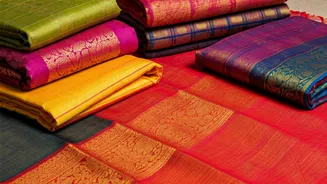
The southern states of India are renowned for their sarees, which often possess an architectural grandeur and refined craftsmanship. Tamil Nadu's Kanjeevaram saree is arguably the pinnacle of Indian textiles, crafted from pure mulberry silk and adorned with opulent zari borders inspired by temple architecture. Kerala champions a simpler, yet equally elegant aesthetic with its Kasavu saree, a crisp white cotton drape edged with radiant gold, embodying understated luxury. Karnataka's Ilkal saree is easily identified by its distinctive contrasting red pallu, known as the 'tope teni' weave, offering a unique visual appeal. Andhra Pradesh contributes the Uppada Jamdani, a remarkably light and airy saree featuring delicate zari work that shimmers beautifully. Telangana completes the southern quartet with the Pochampally Ikat, celebrated for its incredibly smooth silk-cotton blend and sharp, geometric designs achieved through precise ikat dyeing techniques.
Northern Heritage & Mountain Grace
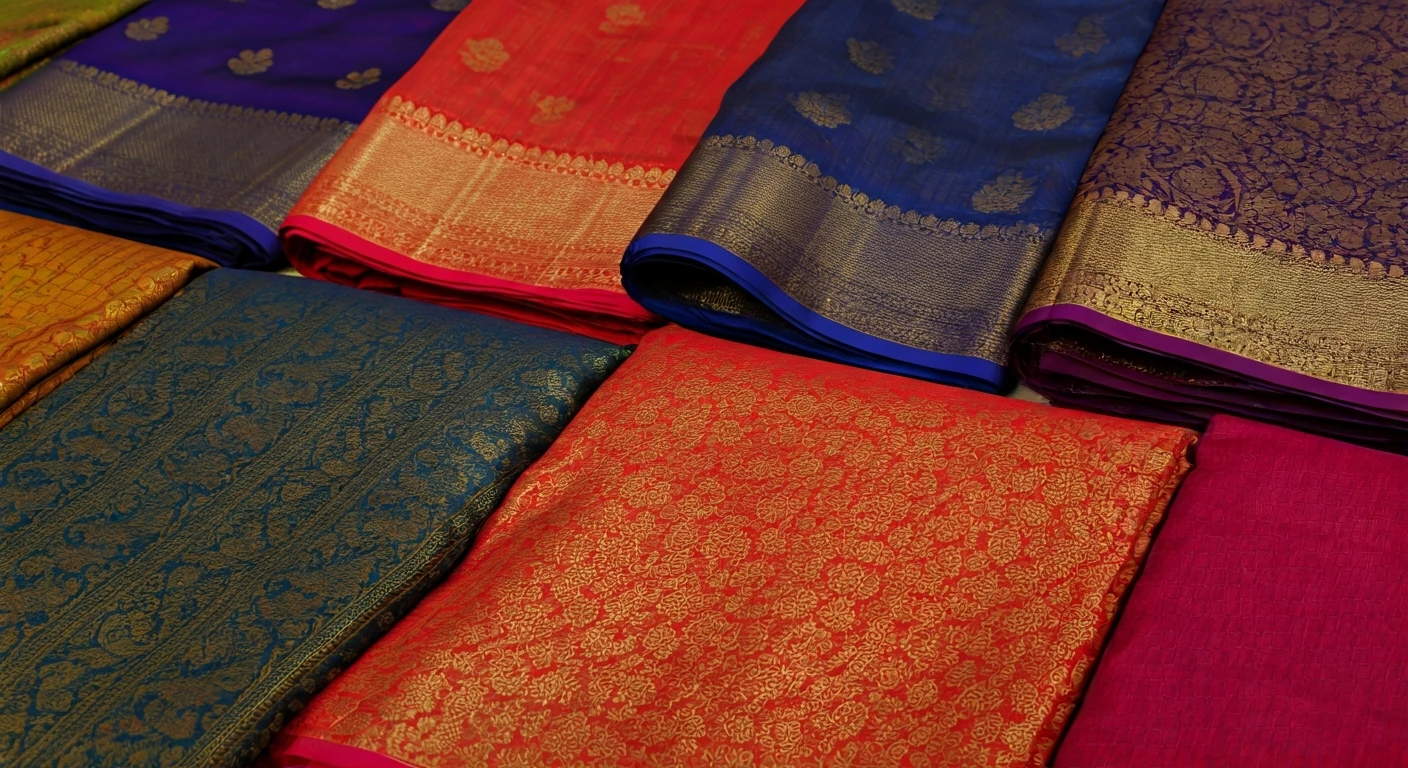
Northern India's textile traditions blend regal heritage with practical mountain sensibilities. Uttar Pradesh is famous for the Banarasi saree, a lavish creation featuring intricate brocades of gold and silver floral motifs that exude an immediate sense of grandeur and luxury. In contrast, Punjab showcases the Phulkari saree, a riot of color and joyful expression, adorned with vibrant, intricate floral embroidery. Haryana offers a comfortable yet festive option with the Resham Dhuria, which combines silk embroidery with soft cotton fabric, making it both elegant and wearable. Moving towards the mountainous regions, Himachal Pradesh's Kullu Patti sarees are characterized by their vivid geometric borders, often seen on shawl designs, against a backdrop of wool or cotton. Finally, Uttarakhand presents the Panchachuli weaves, embodying fine, understated elegance crafted by women in the Himalayas, reflecting the serene beauty of their surroundings.