





AI Infrastructure Boom
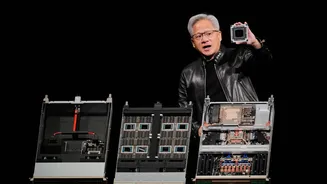
At its annual GTC conference, Nvidia's CEO projected a staggering $1 trillion demand for AI infrastructure between 2025 and 2027. This forecast signals
immense growth opportunities for companies like Nvidia. However, this burgeoning AI ecosystem could present a significant challenge for Tesla, particularly concerning its self-driving technology, which is a major driver of its current investor valuation. Nvidia's expanding role in providing the foundational AI technology for vehicles might dilute the unique advantage investors currently attribute to Tesla's autonomous driving capabilities. The sheer scale of this projected AI infrastructure investment underscores the rapid evolution and widespread adoption of artificial intelligence across various sectors, including the automotive industry.
Nvidia's Autonomous Drive
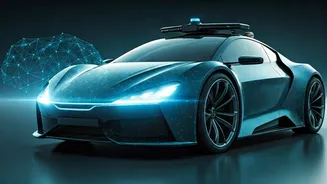
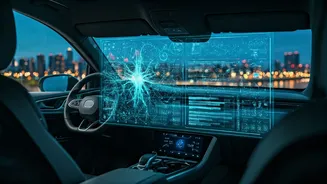
Nvidia's DRIVE platform is engineered to bring advanced artificial intelligence into the automotive world, transforming conventional cars into autonomous robo-taxis. Central to this vision is the DRIVE AGX Thor computer, accompanied by a comprehensive suite of sensors like cameras and lidar. This integrated approach aims to provide a robust solution for automakers looking to deploy self-driving capabilities. For instance, Uber Technologies has announced ambitious plans to deploy a fleet of these DRIVE-enabled robo-taxis across 28 global markets by 2028. Such a move, which could have been a significant opportunity for Tesla with its own Cybercab and robo-taxi initiatives, now highlights a competitive landscape where Nvidia is enabling a broader range of players in the autonomous vehicle space.
Broader Industry Adoption
The influence of Nvidia's autonomous driving solutions extends beyond ride-sharing giants. Major automotive manufacturers worldwide are increasingly integrating Nvidia's DRIVE platform into their own autonomous driving strategies. Companies like BYD from China, Hyundai Motor from South Korea, and Nissan from Japan have all declared their intentions to adopt Nvidia's technology for their autonomous driving programs. This widespread adoption by key industry players means a significant increase in the number of vehicles equipped with advanced driver-assistance systems. Consequently, this broader availability and integration of sophisticated AI in vehicles intensifies competition for Tesla's own Full Self-Driving (FSD) product, potentially diminishing its perceived exclusivity and market differentiation.
Valuation Under Pressure
The significance of self-driving technology to Tesla's stock valuation cannot be overstated, especially as traditional electric vehicle sales face challenges. Despite a slump in EV sales in both the U.S. and China, with Tesla experiencing declines for two consecutive years, its stock has seen substantial growth. This surge is largely attributed to investor optimism surrounding the potential of AI-driven robo-taxis to unlock new revenue streams and future earnings growth. For example, Morgan Stanley has previously valued Tesla's autonomous driving technology at approximately $270 per share, translating to a market capitalization of about $1.2 trillion based on its shares. This valuation hinges on the expectation of hundreds of billions in earnings and free cash flow generated from this technology. However, if Nvidia succeeds in commoditizing this technology, making it a standard feature rather than a unique differentiator, it could significantly challenge the rationale behind Tesla's multi-trillion-dollar valuation.
Future Implications
While Tesla's CEO has expressed confidence, stating he is not concerned about Nvidia's self-driving advancements, investors are encouraged to carefully consider the implications of widely accessible autonomous driving technology. The potential for AI capabilities to become a standard feature across many vehicle brands, facilitated by technology providers like Nvidia, could fundamentally alter the competitive landscape. This scenario might shift the perceived value of such technology from a premium differentiator to a widely available commodity. Such a transition could diminish the unique selling proposition that has historically supported Tesla's high valuation, prompting a re-evaluation of its future growth prospects and market position in the evolving era of AI-powered transportation.