




Night Sky Spectacles
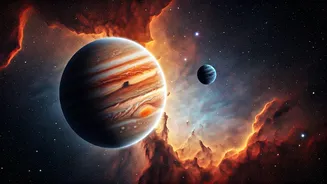
As the week unfolds, keen observers can enjoy a celestial ballet in the evening sky. Look westward for the radiant planet Venus, accompanied by Jupiter
positioned above it, drawing closer each day. Before sunrise, shift your gaze eastward to find Saturn and Mars near the horizon. These visible planets offer a fantastic opportunity to connect with the cosmos, reminding us of the dynamic celestial movements occurring above us. For those eager to delve deeper into these astronomical observations, a comprehensive guide detailing May's night sky phenomena is available, providing further details on what to anticipate and how to best witness these stellar displays. These regular celestial events serve as a consistent reminder of the vastness and beauty of our solar system, encouraging continued engagement with astronomy and space observation.
Galactic Gas Dynamics
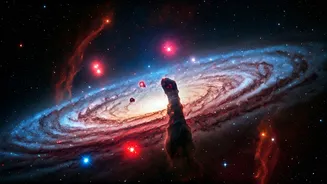
A significant portion of the gas within galaxies never coalesces to form stars. A critical process occurs when massive, young stars ignite, immediately commencing an outward expulsion of material from their stellar nurseries. This energetic stellar activity plays a crucial role in sculpting galaxies on immense scales. The radiation and stellar winds from these newborn giants effectively push away surrounding gas and dust, influencing the distribution and structure of galactic arms and overall galactic morphology. This phenomenon is vital for understanding how galaxies evolve and how the raw materials for planet formation are distributed. The image captured by the James Webb Space Telescope vividly illustrates this, showcasing thousands of stars creating 'bubbles' in the Whirlpool Galaxy's spiral arm, demonstrating the powerful impact of stellar birth on galactic environments and the subsequent availability of material for new stars and planetary systems.
Naming Conventions Unveiled
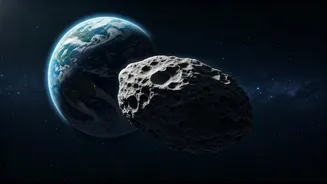
The nomenclature of celestial bodies is a captivating blend of mythology, historical figures, and even whimsical choices. While planets like Mercury bear names from Roman deities, asteroids can be christened with monikers such as 'Potato' or 'Tomhanks,' reflecting a diverse range of naming origins. This practice spans from ancient myths and fictional characters to the imaginative ideas of children participating in naming contests. Exploring the long-standing traditions and evolving methodologies behind how objects in space receive their designations reveals a rich history. Recently, the Artemis II astronauts honored mission commander Reid Wiseman’s late wife, Carroll, by naming a lunar crater after her. Although awaiting formal approval by the International Astronomical Union, this act mirrors historical precedents, such as astronaut Jim Lovell naming a lunar peak 'Mount Marilyn' after his wife during the Apollo 8 mission, which later received official recognition. This practice highlights a human desire to connect and personalize the vastness of space.
Policy and Advocacy Wins
A significant development in space policy advocacy has seen legislative bodies push back against proposed budget cuts for NASA's science initiatives. A House Appropriations subcommittee has recommended funding for the agency at levels comparable to the previous fiscal year. This proposal contrasts sharply with the White House's initial plan, which suggested a substantial 46% reduction in NASA science funding, whereas the House bill proposes a more modest cut of approximately 18%. Simultaneously, members of the corresponding Senate subcommittee have expressed concerns regarding the NASA budget request. This legislative action follows a pattern from the previous year, where a similar bill introduced by the House, proposing comparable cuts to NASA science, ultimately resulted in the agency's budget being fully reinstated, demonstrating successful advocacy efforts in preserving scientific exploration.
Space Exploration Milestones
The Artemis II mission has yielded a remarkable collection of over 12,000 images released by NASA, marking the first human photographs taken beyond low Earth orbit in over five decades. These visuals include stunning perspectives of Earth receding behind the Moon, a solar eclipse viewed from the Moon's far side, and intricate star trails captured as the crew capsule executed rotations. These images offer an unprecedented glimpse into space from a human vantage point, extending our visual understanding of lunar and interplanetary environments. Additionally, the International Space Station continues to face challenges with persistent cracks. While astronauts have managed to seal most of the air leaks in a Russian module, officials from NASA and Roscosmos are still in disagreement regarding the precise cause and potential severity of these issues, indicating an ongoing investigation into the problem that has been a concern for several years.
Artistic Expressions & Awards
The Planetary Society actively celebrates and encourages space-themed artistic expression. They invite individuals to submit their creations by replying to Downlink emails or sending them to a designated address, with a special acknowledgment for Planetary Society members. In recognition of outstanding contributions to planetary science and space exploration, two prominent leaders from the Society, Casey Dreier (chief of space policy) and Jack Kiraly (director of government relations), have received the prestigious 2026 Harold Masursky Award from the American Astronomical Society's Division for Planetary Sciences. This accolade highlights their exceptional service and commitment to advancing the field, echoing the legacy of past recipients like Carl Sagan. Their recognition coincides with a significant 'Day of Action' for the Society, a major event in its history, which is further detailed in the latest episode of Planetary Radio, underscoring the Society's continued dedication to promoting space exploration and scientific understanding through various avenues, including artistic outreach and public engagement.