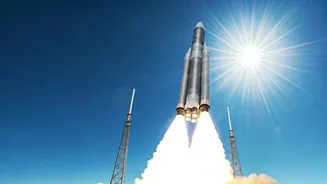

Mission's Core Objective
The primary goal of the LVM3-M6 mission centered on verifying ISRO's technical prowess, particularly concerning the launch of heavy payloads. This mission was
designed to assess the rocket's ability to handle significant weight and operate efficiently in space. This test had profound implications, as a successful launch would validate the design and operational procedures of the LVM3 rocket, establishing its suitability for future, more complex missions. Moreover, it allowed ISRO to scrutinize the cost-effectiveness of this launch vehicle compared to other available options, especially considering the global space market. The outcome directly affects the reliability and financial feasibility of future ISRO endeavors, offering critical data for strategic planning.
Technical Aspects Explored
This launch presented an opportunity to delve into the intricate technical features of the LVM3-M6. Scientists and engineers intently studied several key components, including the rocket's propulsion systems and the structural integrity of the payload fairing. Thorough data analysis was critical to verify how the rocket performs throughout each launch phase, from liftoff to payload deployment. The mission's success hinged on the precision of the guidance and control systems, which determined the trajectory and the final orbital positioning. Every aspect, from the cryogenic engine's performance to the deployment of the satellite, was meticulously recorded and analyzed to gather crucial information about the vehicle’s overall performance, its potential for improvements, and its long-term viability.
Cost Efficiency Examined
Beyond technical performance, the LVM3-M6 launch offered a detailed examination of its cost-efficiency. With increasing global competition in the space sector, ISRO aimed to determine the balance between costs and capabilities. The mission involved assessing various expenses, like manufacturing, labor, and operational overheads. They compared these costs with other available launch vehicle options to accurately evaluate their market position. The goal was to establish a financially sustainable framework for future space missions. By scrutinizing the launch costs, ISRO not only aimed to streamline operations but also to boost its competitiveness in both the commercial and national arenas, thus enhancing India’s global presence in the space industry.
Impact on Space Program
The LVM3-M6 launch had a notable effect on India’s broader space program. A successful mission would enhance the country's prestige and reinforce its technological capabilities in the world. This would open doors to increased international collaborations and opportunities to launch satellites for various nations. The success of this launch would inspire further investment in the space sector, driving innovation and creating new job opportunities for Indian scientists and engineers. More significantly, it would contribute to India's self-reliance in space technology, reducing the need to depend on other nations and paving the way for future space exploration, including ambitious projects like manned missions and lunar exploration.
Future Mission Prospects
The data collected from the LVM3-M6 mission provided crucial insights to shape future space endeavors. ISRO scientists and engineers could leverage this data to refine the rocket's design, leading to improved performance and efficiency. They could also explore advanced technologies like reusable launch systems, thus reducing space mission costs. The launch also set the stage for upcoming missions, like launches of more complex satellites for communications, earth observation, and scientific research. Furthermore, this mission laid the foundation for future endeavors like human spaceflight programs and deep-space explorations, solidifying India’s place as a key player in the global space race. The lessons learned from LVM3-M6 served as a blueprint for continued innovation and sustained development in the years to come.