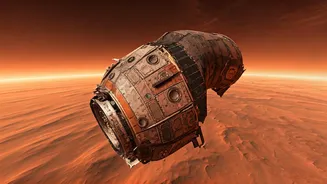








A Martian Mystery Unfolds
The news of a lost spacecraft near Mars has sent ripples through the space exploration community. When an advanced probe disappears, it is not just a technological
failure; it represents a significant setback for the scientists and engineers who have poured their efforts into the project. The challenges of interplanetary travel, including extreme distances, harsh radiation, and the intricate workings of spacecraft systems, constantly bring in the potential for such disruptions. The precise nature of the loss is crucial. The absence of reliable data concerning the probe's final moments makes pinpointing the cause very difficult, with many possibilities considered. Was it a software glitch, a hardware failure, or an external factor? Every question necessitates detailed examination and meticulous analysis to understand what went wrong and to stop it from happening again.
Possible Causes Examined
Investigating what might have led to this loss takes careful consideration. Several reasons are under investigation, and they are not mutually exclusive. A software issue could have sent the spacecraft into an unforeseen trajectory or disabled critical systems. Hardware failures, like issues with the propulsion system, power supply, or communications array, are another possibility. Furthermore, the space environment itself poses risks. The probe could have been hit by a micrometeoroid or been affected by solar radiation. Even a simple error in ground control commands could have had unintended consequences. A detailed assessment of telemetry data, simulations, and any available information from other missions will be important in resolving this mystery. Pinpointing the actual cause is critical to preventing similar incidents in future missions and improving spacecraft design and operational protocols.
Impacts on Research
The disappearance of the spacecraft has consequences that extend beyond the immediate loss. Spacecraft often carry cutting-edge instruments that offer unique views of celestial bodies. Valuable scientific data collection and analysis are stopped. Scientists lose opportunities to collect new details. They also might need to put aside scheduled experiments, like the study of atmospheric conditions, geological features, or the search for potential evidence of past or present life on Mars. Furthermore, the loss affects ongoing research projects. This can lead to delays and require changes in strategy. It also means revising the existing hypotheses. The scientific community will have to deal with these setbacks and will have to rethink the ways that data is collected and missions are planned. The primary task is to get back on track and resume the important work of exploring the red planet.
Lessons for the Future
The unfortunate event, while representing a setback, offers valuable learning opportunities for future missions. Thorough investigations into what occurred are necessary to identify the specific causes. They will lead to improvements in spacecraft design, testing procedures, and operational protocols. Space agencies and engineers worldwide can implement new strategies to manage and mitigate risks better. This can involve enhanced software testing, improvements in hardware reliability, and more robust systems for redundancy and fault tolerance. Moreover, this experience will reinforce the significance of continuous education. Engineers and scientists must be informed about the latest technologies and the importance of thorough planning and execution. The challenges of space exploration underline the necessity of collaboration. Sharing of knowledge and resources among various space agencies becomes critical to advancing exploration efforts.
The Road Ahead
Even in the face of such adversity, space exploration continues. The loss of the spacecraft will undoubtedly spur efforts to improve future missions and to expand the understanding of the vastness of space. The focus will be on resuming scientific investigations. This requires making plans for new missions and maximizing the use of current assets in space. This incident will drive the development of more resilient spacecraft and advanced technologies. The setbacks are part of the process, and NASA and other space agencies remain committed to exploring Mars and other celestial bodies. The journey of space exploration is full of challenges. There will be failures, but with persistence, innovation, and an unwavering commitment to discovery, humanity will continue to reach for the stars.