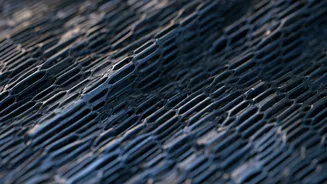







Nano-Scale Strength Secrets
Researchers at the California Institute of Technology (Caltech) have pioneered a novel method for fabricating intricate three-dimensional metallic structures
at the nanoscale. What sets this achievement apart is the unexpected strength and resilience of these minuscule components, even with their deliberately designed porous nature, grain boundaries, and inclusion of impurities. These characteristics, typically viewed as material weaknesses, are actually harnessed to impart exceptional durability. This makes the engineered metal ideal for a diverse array of demanding applications, including advanced medical devices, next-generation computing hardware, and components for challenging space missions where weight and robustness are paramount. Imagine building spacecraft with materials that are significantly lighter yet far more resilient than current options. This innovation could revolutionize how we design and construct critical infrastructure for exploring the cosmos.
Precision Fabrication Process
The innovative technique employed by the Caltech team is known as femtosecond projection two-photon lithography (FP-TPL). This advanced method utilizes a femtosecond laser to precisely shape a light-sensitive liquid precursor into a hydrogel structure. Subsequently, this hydrogel is infused with metallic salts, such as those derived from copper nitrate or nickel nitrate. The composite material then undergoes a two-stage heating process in a specialized furnace. This thermal treatment effectively burns away extraneous material and causes the entire structure to contract, achieving the desired nanoscale dimensions. Remarkably, this process can reduce the overall volume by an impressive 90%, resulting in ultra-compact and dense metallic components.
Defects as Strengths
The material developed by Caltech demonstrates a profound superiority over its macroscopic counterparts, as behaviors at the nanoscale diverge significantly. Even with the presence of inherent 'flaws' like pores and grain boundaries, the nanomaterial exhibits up to 50 times greater strength. This means that components previously deemed unusable due to minor imperfections can now be repurposed or utilized without compromise. Furthermore, the Caltech researchers have validated their findings by integrating the precise microstructural details they observed into computational models. These models proved highly effective in accurately predicting the mechanical properties and strength of the nano-architected material. As stated by Julia R. Greer, the executive officer for applied physics and materials science at Caltech, they were able to incorporate the exact microstructure into their models, moving beyond mere inference to reflect the actual material they fabricated.
Future of Nanotechnology
This remarkable advancement in material science not only validates the accuracy of modeling nano-architected materials but also significantly propels our comprehension and development of future resources. The implications for specialized projects, particularly in the realm of space equipment, are immense. This breakthrough, alongside other burgeoning uses of nanotechnology, signals a bright future for the field. Beyond cutting-edge applications like ongoing research aimed at reversing Alzheimer's disease, nanotechnology is poised to enhance our daily lives. A prime example is the recent breakthrough in LED technology that leverages nanoparticles for more efficient light-based electronics, showcasing the pervasive and transformative potential of this science.