






Record Lunar Distance Achieved
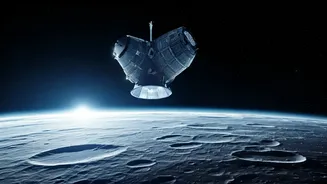
On its fifth day, the Artemis II mission achieved a remarkable milestone, with the Orion spacecraft venturing farther from Earth than any crewed mission since
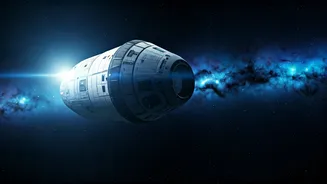
the Apollo era. This extended journey took the astronauts beyond the far side of the Moon, surpassing the previous record set by Apollo 13. This accomplishment underscores the advanced capabilities of the Orion spacecraft and its readiness for deeper space exploration, marking a significant return to human ventures into the vastness beyond our immediate lunar vicinity after more than fifty years. The mission's primary objective was to rigorously test critical systems for future lunar missions, laying essential groundwork for sustained human presence on the Moon and eventual voyages to Mars.
The Diverse Artemis II Crew
The Artemis II mission featured a diverse international crew, comprising three American astronauts and one from the Canadian Space Agency, highlighting global collaboration in space exploration. Leading the mission was Commander Reid Wiseman, accompanied by Pilot Victor Glover. The crew specialists included Christina Koch and Jeremy Hansen, who made history as the first Canadian astronaut to embark on a lunar mission. Together, they navigated their journey around the Moon aboard the Orion spacecraft, diligently evaluating and testing the vital systems and operational procedures essential for NASA's ambitious Artemis program, which aims for future human landings on the lunar surface.
Orion's Perilous Re-entry
The return journey of the Orion capsule marked the most perilous phase of the Artemis II mission, as it hurtled back towards Earth at an astonishing speed exceeding 24,000 mph, or approximately 38,600 km/h. This velocity is nearly 32 times the speed of sound, allowing the spacecraft to traverse the continental United States in roughly seven minutes. To manage the intense heat generated by atmospheric friction, reaching temperatures of about 3,000 degrees Fahrenheit, Orion relied on its robust heat shield, a component largely similar to the one used in Artemis I. NASA's meticulous planning involved adjusting the spacecraft's flight path rather than extensively modifying the heat shield itself to ensure a safe passage through the Earth's atmosphere.
Final Approach and Splashdown
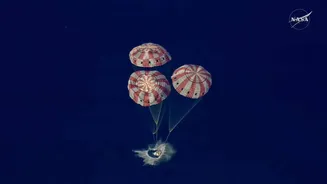
The concluding moments of the Artemis II mission involved a series of precisely timed maneuvers leading to a splashdown in the Pacific Ocean, off the coast of San Diego, California. Approximately five hours before touching down, the Orion spacecraft performed its final thruster burn to refine its trajectory for atmospheric entry. The crew module separated from the service module at 7:33 pm EDT (5:03 am IST on April 11), exposing the heat shield. A subsequent burn at 7:37 pm EDT (5:07 am IST on April 11) adjusted the entry angle. Upon reaching an altitude of 400,000 feet at nearly 35 times the speed of sound, Orion initiated its six-minute communication blackout due to plasma build-up. Drogue parachutes deployed at 8:03 pm EDT (5:33 am IST on April 11) to stabilize the capsule, followed by the main parachutes at 8:04 pm EDT (5:34 am IST on April 11), reducing its speed to under 136 mph. Finally, at 8:07 pm EDT (5:37 am IST on April 11), Orion gently splashed down at approximately 20 mph, concluding a 694,481-mile journey.
Post-Splashdown Recovery Operations
Following the successful splashdown of the Orion spacecraft in the Pacific Ocean, immediate recovery operations were initiated by joint NASA and U.S. military teams. Within two hours of landing, the four Artemis II astronauts were safely extracted from the capsule. They were assisted onto an inflatable raft before being airlifted by helicopter to the USS John P. Murtha. Aboard the ship, the astronauts underwent initial post-mission medical assessments. Subsequently, they were transported back to shore, where awaiting aircraft would carry them to NASA's Johnson Space Center in Houston, Texas, to begin their debriefing and further evaluation after their historic lunar voyage.
Debunking Space Junk Photos
During the Artemis II mission, images captured by the crew did not show any visible 'space junk.' This apparent absence is primarily due to the extreme difficulty of photographing orbital debris. Most debris consists of minuscule particles traveling at incredibly high velocities, often exceeding 28,000 km/h, making them virtually imperceptible to cameras. Furthermore, the highest concentrations of space debris are found in low Earth orbit, a region the Artemis II spacecraft quickly traversed and moved beyond. Even larger objects are challenging to capture due to the vast distances involved and the constant motion. While NASA actively monitors and manages the threat of space debris, the sheer expanse of space and the technical challenges of photography significantly reduce the likelihood of documenting such objects in mission imagery.
The Iconic 'Earthset' View
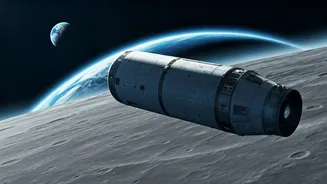
A particularly breathtaking moment during the Artemis II mission was the capture of an 'Earthset' image, a phenomenon where Earth appears to descend behind the lunar horizon. This striking visual is reminiscent of the iconic 'Earthrise' photograph taken during the Apollo 8 mission, which showed our planet seemingly rising above the Moon's surface. This unique perspective offers a profound reminder of Earth's place in the cosmos and the isolation of space travel. The 'Earthset' image serves as a powerful symbol of humanity's exploration beyond our home planet, highlighting the beauty and fragility of our world as seen from afar, and inspiring future generations of space explorers.