



Arvari: Rajasthan's Revival
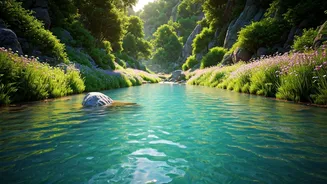
The Arvari River, measuring approximately 90 kilometers, winds through Rajasthan's Alwar district. Remarkably, this river, which once faced desiccation,
has been revitalized through dedicated community-driven water conservation initiatives. Its successful restoration serves as an inspiring blueprint for similar environmental recovery projects across the nation, showcasing the power of local engagement in bringing water bodies back to life and supporting the surrounding arid landscape.
Zuari: Goa's Waterway
As one of Goa's principal short rivers, the Zuari spans about 92 kilometers. This vital watercourse flows westward, eventually merging with the Arabian Sea. It plays an indispensable role in the ecological health of Goa's intricate estuarine systems, supporting a diverse range of aquatic life and contributing significantly to the state's natural beauty and biodiversity. Its presence is integral to the coastal environment.
Mandovi: A Goan Lifeline
The Mandovi River, a significant artery for Goa, covers a length of roughly 77 kilometers. Originating in the verdant Western Ghats of Karnataka, it meanders through Goa, acting as a crucial conduit for transportation, facilitating vibrant fishing industries, and bolstering the state's tourism sector. Its consistent flow and accessibility make it a cornerstone of economic and social activity in the region.
Aghanashini: Undammed Flow
Boasting a length of 121 kilometers, the Aghanashini River is notable for flowing entirely unimpeded by major dams, a rarity in India. This free-flowing nature allows it to sustain a rich tapestry of biodiversity within its waters and along its banks as it empties into the Arabian Sea. Its natural course provides a vital habitat for numerous species, preserving an important ecological corridor.
Sharavathi: Cascading Wonder
The Sharavathi River, extending for approximately 128 kilometers, is most renowned for being the powerful force behind Jog Falls, one of India's loftiest waterfalls. Emerging from the Western Ghats, it makes its journey westward, carving a dramatic landscape. The sheer grandeur of Jog Falls is a testament to the river's strength and a significant attraction that draws visitors from afar.
Palar: Seasonal Strength
With an active flow of about 93 kilometers, the Palar River is largely a seasonal watercourse. Its journey takes it through parts of Karnataka, Andhra Pradesh, and Tamil Nadu. While its active channel might be shorter, its basin influences a larger area, highlighting the intermittent but important role it plays in the hydrology of these southern states during monsoon periods.
Meenachil: Kerala's Heart
Flowing for approximately 78 kilometers, the Meenachil River is a central feature of Kerala's landscape. This river ultimately drains into the expansive Vembanad Lake, a significant backwater system. It is intrinsically linked to the agricultural practices and daily livelihoods of the local populations, providing essential water for crops and sustaining communities along its banks.
Kallada: Irrigation Source
The Kallada River, measuring around 121 kilometers, originates in the majestic Western Ghats. It gracefully flows into Ashtamudi Lake, another notable backwater ecosystem in Kerala. This river is crucial for supporting irrigation needs across the region and plays a role in hydroelectric power generation, contributing to the state's infrastructure and agricultural productivity.
Tunga: Pristine Tributary
As a vital tributary to the Tungabhadra River, the Tunga extends for about 147 kilometers. Its origins lie in the Western Ghats, and it is celebrated for its remarkably clean waters and the picturesque scenery that accompanies its flow. The Tunga provides a serene and ecologically sound water source, contributing to the overall health of its larger river system.
Netravati: Coastal Provider
Though slightly longer at approximately 103 kilometers, the Netravati River is still considered a relatively short but significant waterway. It embarks on its journey and ultimately merges with the Arabian Sea close to the city of Mangaluru. This river is critically important for supplying drinking water to the region and supporting its agricultural sector, making it indispensable for the local population.