



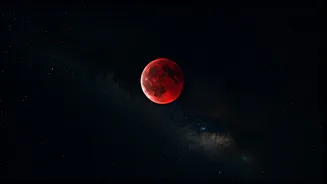
The Crimson Lunar Spectacle
On March 3, 2026, the cosmos will put on a show with a total lunar eclipse, a captivating event where Earth positions itself directly between the Sun and
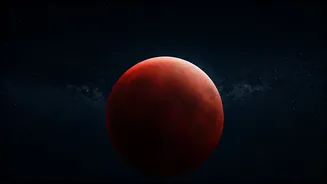
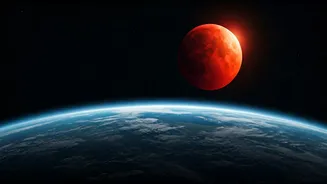
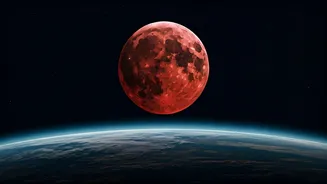
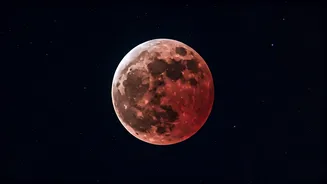
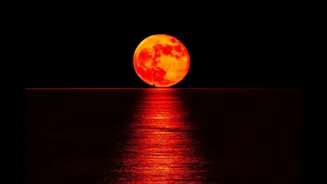
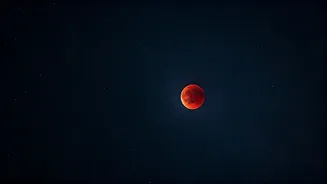
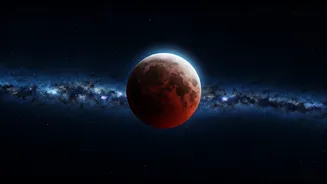
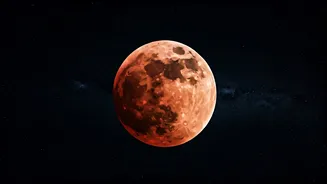
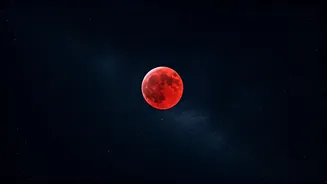
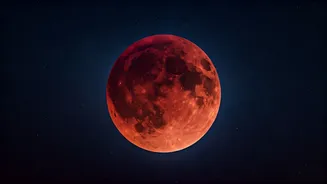
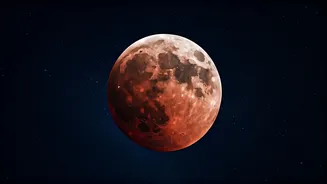
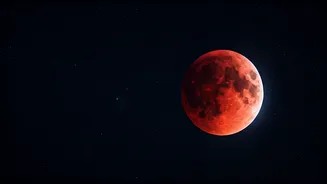
the Moon. This alignment causes Earth's shadow to fall upon the Moon, leading to a phenomenon that astronomers and sky enthusiasts eagerly anticipate. The term 'Blood Moon' is not merely descriptive; it refers to the striking reddish hue the Moon adopts during totality. This isn't an everyday occurrence; lunar eclipses, while not exceptionally rare, are significant celestial events that happen periodically, offering a unique chance to observe our solar system's mechanics in action. This particular eclipse promises to be a memorable experience for all who turn their gaze skyward, a chance to witness a truly awe-inspiring display of cosmic alignment.
Why the Moon Blushes Red
The transformation of the Moon into a 'Blood Moon' during a total lunar eclipse is a fascinating interplay of light and Earth's atmosphere. When the Earth aligns perfectly between the Sun and the Moon, it casts a shadow that obscures the Moon from direct sunlight. However, this doesn't mean the Moon vanishes entirely; instead, some sunlight manages to traverse Earth's atmospheric blanket. As this sunlight bends, or refracts, through our atmosphere, shorter, bluer wavelengths are scattered away, much like how our sky appears blue. Conversely, longer wavelengths of red and orange light are less dispersed and continue on their path, bending to illuminate the Moon. This filtered sunlight is what bathes the lunar surface in its characteristic reddish or coppery glow, earning it the dramatic moniker 'Blood Moon.' It's a beautiful reminder of how our planet's atmosphere can influence what we see from afar.
India's Eclipse View
For sky watchers in India, the total lunar eclipse on March 3, 2026, will present a unique viewing experience, primarily characterized by 'moonrise eclipse' conditions. This means that by the time the Moon ascends above the horizon in various parts of the country, the eclipse will have already commenced. Consequently, the initial phases of the eclipse will not be visible to Indian observers. The opportunity to witness the spectacle will begin only after moonrise, and the duration of visibility will vary depending on the specific location within India. Therefore, while the event is indeed visible from the country, the commencement of the observable portion will be delayed until the Moon is high enough in the sky for observation.
Key Timings for India
The lunar eclipse on March 3, 2026, is scheduled to occur between 03:20 PM and 06:47 PM. However, due to the 'moonrise eclipse' phenomenon, India's visibility will be aligned with the Moon's ascent. The Moon is expected to rise around 06:26 PM, marking the point from which the eclipse can begin to be observed. The peak of the eclipse, when the 'Blood Moon' effect will be most pronounced, is anticipated between 06:33 PM and 06:40 PM. The entire eclipse event will conclude at 06:47 PM. Specific moonrise times will vary slightly across different Indian cities; for instance, in Delhi, it will be around 06:22 PM, while in Lucknow, it will be approximately 06:02 PM. Chennai and Hyderabad will experience moonrise around 06:21 PM and 06:26 PM, respectively, offering viewing windows shortly thereafter.
Global Viewing Opportunities
While India experiences the latter half of the eclipse post-moonrise, other parts of the world will have the opportunity to witness the event at different times. For instance, in Los Angeles, the eclipse will be observable starting at 3:04 AM. Those in Denver will see it from 4:04 AM, and viewers in Chicago and St. Louis can anticipate it from 5:04 AM. Further east, New York and Washington will have a viewing window beginning at 6:04 AM. These varied timings reflect the Earth's rotation and demonstrate how lunar eclipses are visible across vast geographical expanses, though the specific phases and times differ significantly based on local time zones and the celestial body's position in the sky.