
Enceladus's Energetic Pull
Saturn's magnetic field presents a curious asymmetry, a stark contrast to the more symmetrical magnetosphere of Earth. This unevenness is primarily attributed
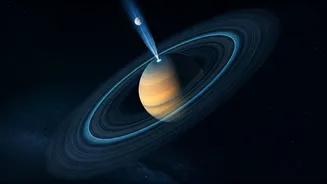
to the planet's swift rotation, which forces a substantial amount of plasma—essentially charged particles—to be dragged along. A significant contributor to this plasma soup is Enceladus, one of Saturn's many moons. Known for its spectacular geysers that erupt icy particles and water vapor from its subsurface ocean, Enceladus constantly replenishes the surrounding environment with these charged materials. As Saturn spins rapidly, this enriched plasma is pulled around, distorting the magnetic field in a way that is not observed on Earth. This phenomenon highlights how moons with active geological processes can profoundly influence a planet's magnetosphere, a concept vital for future space exploration and our understanding of exoplanetary systems.
Rapid Spin Dominance
The research provides compelling evidence for a long-standing theory: for massive, rapidly spinning planets like Saturn that possess active moons, their rotation speed and the resulting plasma outflow can overpower the influence of the solar wind. Unlike Earth, where the solar wind is the dominant force shaping our planet's magnetic shield, Saturn's magnetosphere is fundamentally different. This is largely due to its exceptionally fast rotation, completing a full spin in just about 10.7 hours. This rapid spin, combined with the plasma injected by moons like Enceladus, creates a dynamic environment where internal planetary processes dictate the magnetic field's structure. This discovery is significant for understanding magnetospheres of other gas giants in our solar system and beyond, suggesting a universal principle at play where planetary rotation and moon activity can redefine interactions with stellar winds.
Cassini's Crucial Data
Data gathered by the Cassini spacecraft proved instrumental in deciphering Saturn's magnetic field puzzle. Specifically, the Cassini Magnetometer (MAG) and Cassini Plasma Spectrometer (CAPS) instruments recorded numerous instances, 67 between 2004 and 2010, where the spacecraft traversed Saturn's magnetic cusp. The magnetic cusp is the region where magnetic field lines curve back towards the planet's poles, guiding charged particles into the atmosphere. By analyzing this extensive data, scientists were able to simulate the shape of Saturn's magnetic field and observe its asymmetry. The findings indicate that the interaction between the solar wind and Saturn's magnetosphere bears similarities to that of Jupiter, another gas giant. This comparative analysis across different planetary systems allows scientists to identify fundamental laws governing magnetospheric interactions, crucial for studying exoplanets.
Asymmetry Explained
The research highlights that Saturn's magnetic field is noticeably lopsided, deviating significantly from Earth's more symmetrical magnetic shield. This asymmetry, where the magnetic cusp is observed to be dragged significantly to one side (analogous to a clock face showing 1 or 3 o'clock, compared to Earth's 12 o'clock), is largely explained by the combined effects of Saturn's rapid rotation and the continuous influx of plasma from its moons, particularly the geologically active Enceladus. The constant outpouring of vapor and ice particles from Enceladus's subsurface ocean ionizes and loads Saturn's magnetosphere with heavy plasma. This plasma is then swept around by the planet's swift rotation, creating the observed warped magnetic field. This understanding is pivotal for future missions to the Saturnian system, especially those aiming to investigate Enceladus's potential for harboring life.