






Testing Flight Envelope
NASA and Lockheed Martin's X-59 supersonic jet is undergoing rigorous testing to expand its flight envelope, proving that pushing boundaries involves more
than just speed and altitude. The ultimate objective is to reach Mach 1.4 at 55,000 feet, a condition under which the aircraft is engineered to produce a soft "sonic thump" rather than a disruptive boom. This quiet sonic boom capability is central to gaining regulatory approval for commercial supersonic flights over land, a prospect currently hindered by noise restrictions. Before reaching these ambitious targets, the aircraft has been performing a variety of intricate maneuvers over California's Mojave Desert to validate its operational performance. Initial flights, including its maiden voyage on October 28, lasted over an hour, marking the first performance evaluation. A subsequent flight on March 20 was cut short due to an unexpected "return-to-base call" before reaching its planned speed of 260 mph and altitude of 20,000 feet. After a brief pause, the X-59 resumed its testing schedule. As of April 28, it had accumulated over 11 flight hours across 10 test flights, achieving a maximum speed of Mach 0.95, an altitude of 43,000 feet, and a peak endurance of approximately 1.7 hours. The program has since continued with additional flights, typically scheduled every other day, indicating a steady progression in its development.
Innovative Maneuvers Explained
To meticulously assess the X-59's capabilities, NASA employs chase planes, such as F-15 Eagles, to capture crucial aerial footage. In one observed maneuver, the X-59 executed a "roller-coaster" motion, pitching up and down, which serves to evaluate its stability and control characteristics under dynamic conditions. This helps engineers understand how the aircraft behaves during rapid changes in pitch, akin to an amusement park ride. Another test involved extending the landing gear at controlled airspeeds, a technique designed to measure handling performance by introducing variations in drag, pitch, vibration, and airflow. This particular test can be observed in the released video footage. The aircraft also demonstrated a bank-to-bank autoroll, a smooth transition from banking in one direction to the other, showcasing its agility and precise control. Piloting perspectives reveal seamless execution of these rolls, with pilots communicating their intentions like "right turn, left roll" before smoothly reorienting the aircraft. Furthermore, researchers intentionally introduced vibrations through a flutter excitation maneuver to gauge safety margins across the entire flight envelope. To assess longitudinal stability and trim characteristics, a wings-level push maneuver was performed, where the pilot angles the nose downwards before returning to level flight, providing data on the aircraft's response and equilibrium. Observing the aircraft's approach and landing, detailed at a specific point in the video, offers insight into its low-speed handling and stability.
Design for Quiet Supersonics
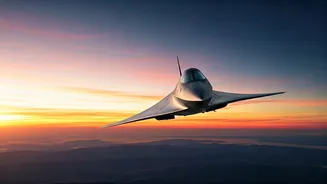
The X-59's distinctive design is key to its ability to mitigate sonic booms. Its most striking feature is an exceptionally long, "Pinocchio-like" nose, extending nearly a third of the aircraft's 100-foot length. This elongated structure is strategically shaped to disperse the shock waves generated at supersonic speeds, preventing them from coalescing into a loud boom. The considerable length of the nose obstructs the pilots' forward vision from the cockpit, necessitating an innovative external vision system. This system utilizes high-resolution cameras to feed real-time imagery to an internal monitor, effectively recreating the necessary forward view. Powering the X-59 is a modified, top-mounted F-18 Super Hornet engine, chosen for its ability to allow for a smooth underbelly design. This smooth surface further aids in breaking up shock waves in the aircraft's wake. The airframe itself is predominantly constructed from aluminum for a balance of strength and weight. To expedite development and ensure reliability, the X-59 incorporates proven components from other established aircraft, including life support systems from the F-15, landing gear from the F-16 Fighting Falcon, a control stick from the F-117 Nighthawk, and a cockpit canopy sourced from the T-38 Talon.
Future of Overland Flight
The successful development and testing of the X-59 are poised to significantly influence the future of supersonic travel over land. The primary objective of the current "envelope expansion" phase is to thoroughly test the aircraft's performance across a wide range of conditions, from high-speed, high-altitude flight to low-speed, low-altitude scenarios. Once engineers are confident in the aircraft's performance and safety, it will be propelled beyond the sound barrier to its intended operational parameters: Mach 1.4 (over 1,000 mph) and an altitude of 55,000 feet. Following these tests, the X-59 will proceed to a specialized supersonic test range at Edwards Air Force Base for validation of its sonic boom-cancelling capabilities. Unlike other supersonic concepts that aim to reduce the impact of a sonic boom reaching the ground, the X-59 is designed to minimize noise generation at its source, thereby aiming for a "sonic thump." This technology is critical for overturning the current U.S. ban on supersonic flight over land, a restriction enacted in 1973 due to noise complaints. NASA plans to conduct extensive community surveys in various locations across the country. These surveys will involve approximately 80 flights over a month-long period in each location, allowing residents to experience the X-59's sonic thump. The gathered data, particularly the public's reaction to the noise levels, will be crucial in providing regulators, such as the FAA, and lawmakers with the evidence needed to reconsider and potentially revise the existing ban. NASA intends to share these findings with international aviation bodies like the International Civil Aviation Organization (ICAO) to foster global alignment on future supersonic flight standards, potentially allowing designs like the X-59 to be adopted by commercial developers.