


Black Holes Unleashed
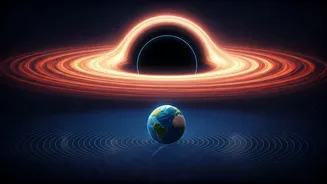
Black holes, those cosmic giants, continue to fascinate scientists. NASA's Chandra telescope used 'X-arithmetic' to examine how these powerful entities
shape galaxy clusters, providing crucial insights. Moreover, a rule-breaking black hole was observed destroying a star in an unexpected manner, leaving researchers puzzled. These observations help scientists understand how black holes influence their surroundings and contribute to the evolution of galaxies. This understanding extends to the activation of supermassive black holes, which, according to research, is triggered by galaxy mergers.
Supernova Spectacles Revealed
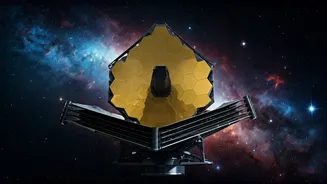
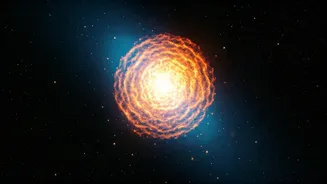
The death of stars and the resulting supernova explosions have offered fascinating insights into stellar evolution. Scientists have witnessed a supernova shockwave moving through a dying star for the first time. The James Webb Space Telescope (JWST) also spotted a dust-cloaked 'red supergiant' star just before it became a supernova, offering a rare glimpse into this cosmic event. Furthermore, astronomers are studying the various stages of dying stars, like W Hydrae, through different molecular lines using ALMA, showcasing 30 of 57 images. These observations are contributing significantly to comprehending how stars end their lives.
Exoplanet Explorations
The quest to find and understand exoplanets continues. The James Webb Space Telescope (JWST) discovered a hot Jupiter exoplanet with twin gas tails, a finding that has defied easy explanation. Another 'super-puff' exoplanet, was observed losing its atmosphere through the JWST. Subaru Telescope recently made its debut discoveries, uncovering a 'failed star' and an exoplanet. The study of exoplanets also extends to their environments. The discovery of a red giant star with a nearby companion and that this proximity could have serious implications, adds to the complexity and excitement of understanding other planetary systems.
Cometary and Stellar Encounters
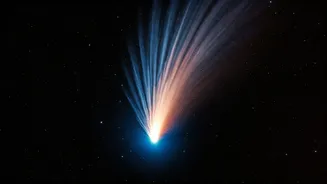
Beyond planets and black holes, other celestial bodies reveal valuable scientific insights. Scientists tracked interstellar comet 3I/ATLAS leaving the solar system in real time. Also, they observed that it left a trail of dust, providing information about its journey. In interstellar space, scientists discovered a cosmic 'scar' in interstellar clouds, created by a close encounter between the Sun and two intruder stars. These encounters, whether between stars or comets, help to understand the dynamics and evolution of cosmic structures over time. These observations offer a unique view into the interstellar environments that also shape our solar system.
Observational Challenges Ahead
The field of astronomy faces significant challenges. Satellite constellations are predicted to hinder telescope observations by the late 2030s, potentially obscuring images. Despite these challenges, astronomers are finding innovative ways to unravel the cosmos. Rare images highlighted active sunspots before they emitted powerful X-flares that triggered the stunning auroras observed in November 2025. Meanwhile, the James Webb Space Telescope's potential discovery of the first stars is sparking further research. These findings demonstrate the tenacity of scientists to continue exploring the universe, despite existing barriers.