







Challenging Market Fears
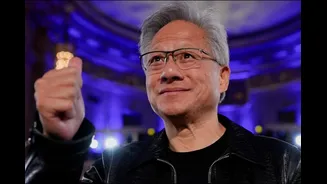
Nvidia CEO Jensen Huang has directly addressed widespread investor concerns that artificial intelligence agents pose an existential threat to the Software-as-a-Service
(SaaS) sector. He asserts that the market's current interpretation of this disruption is fundamentally flawed. Huang believes that instead of rendering these software providers obsolete, AI agents will become powerful tools that operate within and leverage existing SaaS platforms. This perspective challenges the prevailing narrative of a 'SaaSpocalypse,' a term reflecting the fear that AI will render traditional software services redundant. Huang's viewpoint is that these established tools, crucial for numerous business functions, will find new life and increased relevance through intelligent AI augmentation, ultimately serving to amplify human capabilities and efficiency rather than diminish the need for the underlying software.
AI as an Enhancer
Huang's core argument is that AI agents will not serve as replacements for established software tools but rather as intelligent intermediaries that utilize them on our behalf. He draws a compelling analogy, questioning the necessity of rebuilding foundational technologies like web browsers or spreadsheet applications when perfectly functional versions already exist. Instead, he posits that AI agents will be specifically designed to interact with these tools, much like how services like ServiceNow are exceptionally adept at their specific functions. These agents will be finely tuned to leverage the capabilities of existing software, performing complex tasks and optimizing workflows in ways that are currently beyond human capacity or efficiency. The ultimate goal, according to Huang, is to have these AI agents complete tasks and then present the information in an easily digestible format for human comprehension and decision-making.
The Future of Work
Addressing the potential for AI agents to replace not only tools but also the humans who developed them, Huang offers an optimistic outlook. He emphasizes that AI is set to become a powerful collaborative partner, significantly augmenting human capabilities. While acknowledging that the nature of software development will evolve, he anticipates a continued, and indeed an increased, demand for software engineers. However, their roles will shift from traditional coding to working at a higher level of abstraction, guiding and directing AI agents. Huang envisions a future where he, as CEO, will manage a hybrid workforce of both biological and digital employees, with the latter numbering in the hundreds of thousands. This synergistic relationship between humans and AI will necessitate the use of a substantially greater volume of tools and software.
Nvidia's Performance
Jensen Huang's insights into the future of AI and SaaS emerge shortly after Nvidia's impressive financial disclosures. The chip giant reported a robust 73 percent revenue increase for the January quarter, concluding their fiscal year 2026. Over the entirety of this fiscal year, Nvidia achieved a staggering $216 billion in revenue, complemented by a net profit of $120 billion, resulting in a remarkable profit margin of 55.6 percent. Following the release of these favorable earnings, Nvidia's stock saw a 2 percent rise in extended trading, underscoring market confidence in the company's performance and its pivotal role in the burgeoning AI landscape. This financial success provides a strong backdrop to Huang's forward-looking statements about AI's integration with existing software paradigms.