





A Giant Under Construction
The Giant Magellan Telescope (GMT) project, a collaborative effort involving 16 leading universities and research institutions, is currently navigating
its final design blueprints. This pivotal stage is essential for securing substantial federal funding. The upcoming 12 to 24 months are deemed critical for charting the telescope's trajectory. If development receives the green light, full-scale construction could commence as early as 2028. This monumental undertaking has already undergone numerous independent technical assessments, with over $1 billion already invested. Remarkably, approximately 40 percent of the telescope's intricate components are already in various phases of production, signifying significant progress despite the funding uncertainties.
Chile's Pristine Skies
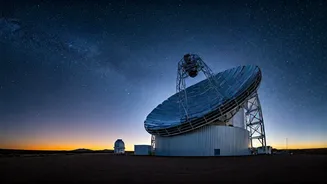
Selected for its unparalleled astronomical potential, the GMT will be situated at the Las Campanas Observatory in Chile's Atacama Desert. This region is renowned for its exceptionally clear, dry, and stable atmospheric conditions, providing an optimal environment for observing the cosmos. Preparatory work on the site is well underway, encompassing the establishment of essential infrastructure such as access roads, utility networks, and crucial support facilities. Simultaneously, engineers in the United States are meticulously crafting the massive structural mount designed to house the telescope's colossal mirrors and sophisticated instruments. Once fully assembled, this impressive structure is projected to stand nearly 39 meters tall and weigh an astonishing 2,600 tonnes, a testament to the scale of this engineering marvel.
Revolutionary Mirror Design
What distinguishes the GMT is its groundbreaking optical architecture. Instead of employing numerous smaller mirror segments, it will integrate seven of the largest monolithic mirrors ever manufactured, each boasting an impressive diameter of 8.4 meters. These seven mirrors will function in concert, creating a single, powerful reflecting surface. This advanced primary mirror system will be complemented by an sophisticated adaptive optics system. This technology will dynamically adjust the mirrors' configurations thousands of times per second, effectively counteracting atmospheric distortions and enabling exceptionally sharp and clear images of celestial objects. This innovative approach promises unprecedented clarity in astronomical observations.
Seeking Life Beyond Earth
The GMT is anticipated to make a profound impact on the study of exoplanets, particularly those residing within the habitable zones of their parent stars. Astronomers aim to analyze the light passing through or reflecting off these distant worlds to detect atmospheric biomarkers, potential indicators of life-supporting conditions. Beyond the search for extraterrestrial life, the telescope will grant scientists the ability to gaze billions of years into the universe's past. It will offer unprecedented views of the formative stages of galaxies and shed light on the crucial flow of gas into and out of galaxies, a fundamental process that fuels star formation. This capability will significantly enhance our understanding of cosmic evolution.
Funding Remains Key
The overarching challenge currently facing the GMT project is securing adequate funding. The estimated total expenditure for the development and ongoing operation of the telescope is projected to exceed two billion dollars. Without the necessary financial backing, the project could face significant delays, potentially slowing its development pace or even jeopardizing its completion. Once operational, the GMT will join a suite of next-generation telescopes scheduled for deployment in the coming decades. Collectively, these advanced instruments are expected to provide scientists with a dramatically clearer and more comprehensive view of the universe, potentially leading to groundbreaking discoveries about galaxy formation and the prevalence of habitable planets across the cosmos.