






Bridging the Ocean Data Gap
The vastness of our oceans presents a significant challenge for monitoring activities, from governmental oversight to commercial shipping and insurance
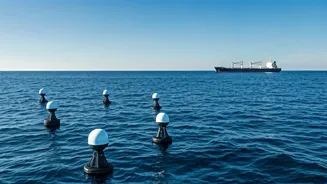
assessments. A primary hurdle is the prevalent lack of modern technological integration on many vessels, coupled with insufficient software to interpret the data collected by existing sensors. This gap leaves critical maritime information elusive. Addressing this, a burgeoning company has developed a sophisticated solution, aptly named "SmartMast." This system is essentially a robust package of weather-resistant sensors, including cameras and radios, strategically mounted on a ship's mast. These sensors are designed to transmit live maritime data, which is then processed by an advanced analytics platform. Quartermaster describes this integrated approach as a 'continuous, distributed sensing network,' effectively creating a collective intelligence for the countless ships traversing the globe.
SmartMast vs. Outdated AIS
The company behind SmartMast asserts that its technology represents a significant leap beyond the current industry standard known as AIS, or the Automatic Identification System. AIS, in its current form, is described as rudimentary, primarily functioning by relaying basic location pings. Furthermore, AIS is susceptible to manipulation and fraud, a considerable issue in maritime operations. Quartermaster's CEO and founder, Neil Sobin, highlights the inherent flaws in AIS, stating, 'In maritime, AIS is a completely broken system. It’s opt-in, [you] enter your own data, and if you want to do anything nefarious on the ocean, from petty smuggling all the way up to sanctions evasion, you can simply opt out of the system, or spoof it.' He emphasizes the fragility of AIS, suggesting that its vulnerabilities can be easily exploited. In contrast, SmartMast aims to provide a more secure and reliable data stream, mitigating the risks associated with fraudulent reporting and system non-compliance, thus offering a more trustworthy picture of oceanic activities.
Securing Funding for Growth
Following a consistent presentation of its innovative vision to potential investors, the company has successfully secured a substantial $43 million in Series A funding. This significant investment, announced recently, was jointly led by prominent venture capital firms, First Round Capital and Quiet Capital, the latter known for supporting early-stage entrepreneurs. Bill Trenchard, a partner at First Round Capital with a notable track record, including leading Uber's seed round, commented that Quartermaster is 'reshaping how maritime operators understand and act on the world’s oceans.' He further elaborated on the company's achievement by noting, 'Most attempts to bring intelligence to the ocean have run into the same wall: The cost of bespoke hardware does not scale to a planet that is mostly water. Neil and his team have solved that.' This funding is expected to fuel the company's expansion, particularly in bolstering its engineering team to accelerate technological development and solidify its position in the maritime intelligence sector.
Impact and Future Applications
To date, vessels equipped with the SmartMast system have collectively covered an impressive 10 million square miles of ocean, with over 600 ships participating in this network. The core objective of this initiative is to establish a foundational layer of intelligence for various applications. This includes accurately identifying other vessels, generating crucial training data for companies developing autonomous marine systems, and providing vital support to scientists and robotics experts. Additionally, the data collected offers valuable insights for governmental agencies. The potential applications are vast, with the company already witnessing new uses for its technology. For instance, ships utilizing SmartMast have been instrumental in facilitating more than 20 rescues of mariners at sea. While not a direct revenue stream, these efforts underscore a commitment to enhancing mariner safety and foster goodwill, which in turn strengthens the network and encourages further participation. This 'pro-mariner' approach, coupled with incentives, is seen as a key differentiator in a market where competitors often struggle with difficult pitches to low-margin fleet operations.
Engineering for the Ocean
A significant portion of the recently acquired funding is earmarked for expanding the engineering team, a critical step in advancing Quartermaster's technological capabilities. The company believes that the sheer potential of oceanic exploration and problem-solving will attract top engineering talent. Sobin points out that 'The ocean has so much low-hanging fruit in computer vision tasks.' He contrasts this with the challenges faced by engineers in other tech sectors, where the impact of their work can feel diffused. For instance, he notes that for engineers at social media companies or AI labs, it's 'hard to feel the reward of all of your effort.' In contrast, he suggests that 'On the ocean, a single engineer can come in and make a significant impact in relatively short periods of time, simply because no one has worked on the space before.' This environment offers a unique opportunity for engineers to make tangible contributions and drive innovation in a largely untapped domain.