




Squat Setup Woes
Many lifters experience discomfort or awkwardness when setting up for a barbell back squat, often attributing it to simple poor shoulder mobility. However,
this tightness is a critical signal from your body indicating that something is fundamentally wrong with your positioning. A proper back squat setup requires the creation of significant tension throughout your entire upper back, ensuring the barbell is locked into a stable, secure position. Crucially, you need to find a hand grip that is comfortable for both your wrists and shoulders, avoiding any undue strain. When this initial setup feels compromised, it often leads to a cascade of compensatory movements, such as your elbows flaring outwards unnaturally, your wrists experiencing pain, your chest collapsing inwards, or the bar simply not feeling secure. Instead of merely trying to push through this discomfort by widening the grip or 'toughing it out,' the real solution lies in improving the mobility and capacity of your shoulders, the intricate network of muscles in your upper back, and the surrounding soft tissues that facilitate a strong, stable foundation.
Assessing Your Squat
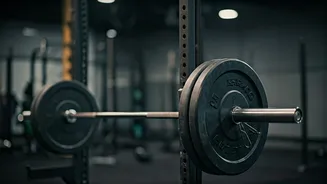
To pinpoint issues with your back squat setup, a straightforward self-assessment using just an empty barbell can be highly effective. Begin by stepping under the bar as you normally would for a back squat, ensuring your hands are positioned slightly wider than shoulder-width, or at your preferred grip. Check that your wrists are in a relatively neutral position, not excessively bent backward, and that your elbows are angled slightly downwards and inwards, rather than flaring upwards. Aim to maintain a tall chest without overextending your upper back, and confirm the bar rests securely across your upper back. Hold this position for about 10 to 15 seconds. During this hold, pay close attention to any sensations of discomfort in your anterior shoulders, elbows, or wrists, and observe if your elbows tend to drift upwards and outwards, or if your chest starts to collapse. If you cannot maintain this position without pain or significant deviation, it indicates that your current setup is flawed, and adding weight will only exacerbate these underlying problems.
Keys to Positioning
Achieving an optimal back squat requires more than just hand placement; it's built upon a foundation of key physical attributes. Adequate shoulder external rotation is vital, allowing your hands to find their position on the bar without forcing your wrists or elbows into unnatural angles. Furthermore, maintaining thoracic extension, essentially keeping your upper back tall and proud, is essential for effectively supporting the barbell's weight. The length and suppleness of your latissimus dorsi and pectoral muscles play a significant role; tightness in these areas can pull your shoulders forward, hindering your ability to create a stable 'shelf' for the bar. Proper scapular retraction and depression are also critical for 'locking' the bar into place on your upper back, preventing any unwanted movement during the lift. Finally, your wrist positioning and tolerance are paramount, as your hands act as guides for the bar, not the primary support. Any deficiency in these areas undermines the stability of your squat before you even begin the movement.
Face Pull Rotation
The Band Face Pull with External Rotation is a targeted exercise designed to enhance shoulder stability crucial for squatting. This variation involves pulling a resistance band towards your face and concluding with an external rotation of your shoulders, bringing your hands up and back. This movement directly addresses the common issue of insufficient external rotation, which can lead to a compromised bar position, elbow flare, and an unstable upper back. By performing this exercise, you develop the necessary combination of scapular retraction and external rotation to achieve a more secure and advantageous upper-body positioning for your back squat. To perform it, anchor a looped resistance band at roughly face height. Grip the band with both hands, shoulder-width apart, palms facing down. Pull the band towards your face, initiating the movement with your elbows. As the band nears your face, rotate your hands upward and backward, aiming for a 'goal post' arm position. Lower the band back with control. A recommended protocol is to perform 2 sets of 10-12 repetitions before squatting, or incorporate 1-3 sets of 10-12 reps into your general warm-up routine.
Rotator Cuff Control
The External Rotation with Elbow on Knee exercise is a focused drill to improve rotator cuff control and target a specific range of motion often problematic for lifters. Many individuals struggle to achieve the necessary external rotation during their squat setup, which forces their elbows out of position and their wrists into painful extremes. This exercise meticulously develops control within this critical range, which is fundamental for a solid back squat grip. To execute this movement, sit upright on a bench with one elbow resting on your knee, providing stable support. Hold a light dumbbell in that hand, with your elbow bent at a 90-degree angle. Slowly rotate your forearm upwards towards the ceiling while ensuring your elbow remains stationary. Control the movement throughout the upward and downward phases. Perform 2 sets of 8-10 repetitions on each side as a pre-squat warm-up to enhance your shoulder's ability to externally rotate effectively and safely.
TRX Y-Raise
The TRX Face Pull to Y (Eccentric Overload) exercise combines two effective movements to build both strength and control through an extended range of motion. Initially, you engage in a face pull to strengthen external rotation using only your body weight. Subsequently, the Y raise phase, particularly with an emphasis on a slow lowering (eccentric) portion, enhances upper back strength and improves posture. To perform this, position yourself with your feet appropriately to achieve your desired level of intensity and grip the TRX handles with an overhand grip. Pull your body towards the handles, bringing them towards your face, and pause briefly in a face-pulling position with your elbows at shoulder height. From this position, transition smoothly into an overhead Y-raise. The key element is to slowly lower yourself back down to the starting position, then reset and repeat. A suggested programming approach is to complete 2-3 sets of 6-8 repetitions before your squat session, focusing intently on a controlled and deliberate eccentric phase during the Y-raise portion.
Deep Squat Lats
Tight latissimus dorsi muscles can significantly impede your ability to get under the barbell and maintain the crucial thoracic extension needed for a stable squat shelf. The TRX Deep Squat Breathing with Lat Stretch addresses this by integrating a deep squat hold, an overhead reach, and diaphragmatic breathing, simultaneously working on shoulder mobility, lat length, and proper squat positioning. To perform this exercise, hold the TRX straps at shoulder height and sink into a deep squat, ensuring your torso is positioned comfortably over your thighs. Extend your arms overhead, actively feeling a stretch across your lats. While in this position, take a deep, diaphragmatic breath, feeling your belly expand against your thighs. Exhale slowly and repeat the breathing cycle. A practical recommendation is to perform 1-2 sets, focusing on 6 deep breaths, as part of your pre-barbell warm-up to open up the shoulders and lats effectively.
Pec Stretch Control
Tight pectoral muscles can pull the shoulders forward into internal rotation, making it challenging to achieve an optimal hand position on the bar, keep your elbows down, and establish that firm upper back shelf essential for a strong back squat. The Pec Stretch with Lift-Off, performed against a wall, effectively addresses this by not only opening up the front of the shoulder but also by training controlled movement within this newly acquired range. To perform it, stand facing a wall. Place one arm in a 'goal post' position against the wall, with the elbow bent. Position your other arm similarly or resting on the wall. Gently press your torso away from the wall until you feel a stretch across your chest and shoulder. After a few repetitions to warm up the area, at the end range of the stretch, actively rotate your forearm away from the wall. Hold this rotated position for 2-3 seconds, then return your forearm to the wall. Repeat this for controlled repetitions before switching sides. A good guideline is 1-2 sets of 5 lift-offs per side, ideally paired with face pulls for synergistic benefits.