







Tunneling Milestone Achieved
A significant stride has been made in the ambitious Mumbai-Ahmedabad High Speed Rail (MAHSR) project with the commencement of assembling one of the two
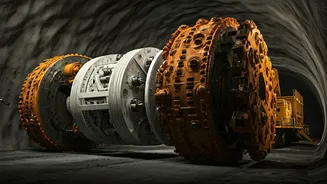
Tunnel Boring Machines (TBMs). These powerful machines are destined for a 21-kilometer underground tunnel that will connect the Bandra Kurla Complex (BKC) to Shilphata in Mumbai. This particular section is considered one of the most intricate parts of the entire 508-kilometer corridor, demanding advanced engineering solutions. The initial assembling process is projected to span approximately 97 days before the machine is fully operational and ready to begin its excavation duties. This undertaking signifies a major leap forward in constructing the nation's first high-speed rail network, tackling complex geological and urban environmental challenges with state-of-the-art technology. The goal is to create a seamless, high-speed link between these two major Indian cities.
Advanced Tunneling Technology
The subterranean stretch between BKC and Shilphata is a formidable part of the MAHSR, notable for its complexity. While 5 kilometers of this tunnel have already been excavated using the New Austrian Tunneling Method (NATM), which relies on controlled blasting, the remaining 16 kilometers will be the domain of these sophisticated TBMs. These machines, supplied by the renowned German company Herrenknecht, are specifically engineered for the demanding geological strata found in the region. The tunnel itself is designed as a single tube structure, boasting an impressive 13.1-meter diameter to comfortably house twin railway tracks. Its depth will vary from 25 to 57 meters below the surface, reaching its deepest point at a staggering 114 meters beneath the Parsik hill. The two TBMs, weighing a substantial 3080 tons (TBM-1) and 3184 tons (TBM-2), are at the forefront of tunneling technology in India. They employ a Mix Shield/Slurry technology, enabling them to navigate complex underground conditions with remarkable efficiency and precision, a crucial requirement given the proximity to numerous residential buildings.
Logistics and Deployment
The deployment of these massive TBMs involves meticulous logistical planning. Key components of the machines are being transported from the Jawaharlal Nehru Port, with all shipments slated to depart by April 12th. The two primary assembly sites are strategically located: Vikhroli, a well-known suburb of Mumbai, and Savali in the Ghansoli area of Navi Mumbai. The initial stage of assembly has already seen the careful lowering of one of the six main shield segments, an enormous piece weighing approximately 170 metric tons. This segment, measuring about 8.66 meters in length and 7 meters in width, was positioned at a depth of 56 meters below the ground—comparable to the height of a 20-story building. Once fully assembled, each TBM will extend to an impressive length of nearly 96 meters, signifying the scale of the machinery involved in this monumental construction effort.
Precision and Safety
The choice of TBMs over conventional excavation methods like NATM is driven by the critical need for precision and safety, especially considering the tunnel's route passes beneath approximately 600 residential buildings. The potential risks associated with blasting in such a densely populated urban environment are significantly mitigated by the TBMs' controlled and systematic approach. Furthermore, the MAHSR project includes India's first 7-kilometer undersea tunnel beneath the Thane Creek, a challenge that necessitates the advanced capabilities of these machines. The TBMs are equipped with a cutter wheel that can rotate at a maximum speed of 4 revolutions per minute (RPM) and excavate at a rate of up to 49 millimeters per minute. This meticulous excavation process ensures minimal disruption to the surface and underlying structures. This project marks the introduction of a semi-automatic TBM to India, capable of simultaneously drilling and deploying tunnel segments, a feature that enhances efficiency compared to previous TBM applications.