




A Cosmic Intruder
Interstellar comet 3I/ATLAS, a celestial body originating from outside our solar system, captured the attention of astronomers due to its unexpected close
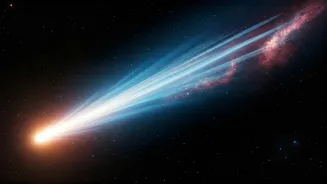
approach to Earth. This event provided a golden opportunity to study an object that hadn't originated within our cosmic neighborhood. Scientists closely monitored the comet's trajectory and behavior, utilizing various telescopes and probes, including the Hubble Space Telescope and the JUICE Jupiter probe, to gather data. The comet's appearance and behavior aligned with the characteristics of typical comets, further enriching our understanding of these icy wanderers. Its presence and path through our solar system made it an early Christmas gift for scientists eager to learn more about the interstellar space. The comet's journey offered an unprecedented chance to examine an object from a distant origin, furthering our comprehension of the vast universe and its diverse inhabitants.
NASA's Stellar Glimpses
NASA unveiled a collection of new images showcasing interstellar comet 3I/ATLAS, providing astronomers with invaluable data about the object's physical attributes. The images captured by both the Hubble Space Telescope and the JUICE Jupiter probe offered a detailed look at the comet's structure. These images revealed that the comet looked and behaved in the manner expected of a comet, giving more information about interstellar space. Researchers examined the comet's dust, gas composition, and the changes it underwent as it traversed the solar system. The data gathered from these images helped in understanding the comet's origins, its composition, and its interactions with the solar wind and radiation. These observations significantly enhanced our understanding of interstellar comets and their role in the broader context of cosmic evolution.
Close Approach Details
The close approach of comet 3I/ATLAS to Earth held special significance for astronomers, providing an extraordinary opportunity to study an interstellar visitor in detail. This approach allowed scientists to observe the comet from a relatively close distance, capturing high-resolution images and gathering more data. Such close encounters enable scientists to analyze the comet's composition, structure, and behavior in greater detail. This allowed for an in-depth analysis of the comet's nucleus, its tail, and the surrounding coma. The close encounter allowed for a comprehensive understanding of the comet's journey through our solar system, providing invaluable insights into its origins and the conditions it experienced during its interstellar voyage. The close approach was an exceptional event for astronomical observation.
Comet's Departure Unveiled
Scientists observed the comet 3I/ATLAS's departure from the solar system in real-time. This provided valuable insights into the behavior of such celestial bodies as they journey out of our cosmic neighborhood. The monitoring of the comet during its exit revealed essential details about its dynamics and the forces acting upon it. This real-time observation allowed scientists to record how the comet's tail changed, how its activity diminished, and how it was affected by the sun's gravity. The departure phase of the comet offered a unique perspective on the long-term changes that interstellar visitors undergo as they traverse vast cosmic distances. The observed departure of the comet enriched our knowledge of comets and their behavior within the context of the solar system. This real-time tracking provided prime-time science, delivering key data on celestial wanderers.
Astronomers' Discoveries
The discovery of interstellar comet 3I/ATLAS and the study of its journey represents a significant achievement for astronomers. These investigations provide a great opportunity to explore the cosmos and understand the composition of comets. The tracking of comet 3I/ATLAS has resulted in enhanced insight into cometary characteristics and their place in the universe. Scientists continue to analyze the data gathered from this interstellar comet. Such studies provide an opportunity to broaden the scientific community's understanding of the cosmos.