





Bennu: A Cosmic Treasure
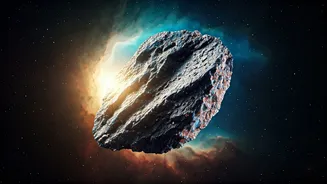
Asteroid Bennu, a celestial body, has become a focal point of intense scientific scrutiny. NASA’s dedicated efforts have focused on analyzing this space
rock, providing insights into the origins of life's fundamental components. The primary focus of the research involved examining samples brought back from Bennu. These samples, which included both stardust and a mysterious substance dubbed 'space gum,' provided crucial data. These findings are important, as they offer clues about the building blocks of life. This recent investigation by NASA has helped illuminate the presence of life-linked ingredients in a setting beyond Earth.
Sugars of Space
The discovery of sugars within Bennu's material is particularly significant. Sugars, being essential to life's processes, are often associated with the formation of DNA and RNA, which act as crucial genetic instructions. The detection of these sugars in the asteroid's stardust presents a compelling perspective. It supports the hypothesis that life’s initial components might have originated in space. This discovery has significant implications. It suggests that asteroids, like Bennu, might have played a role in delivering these critical building blocks to early Earth, which may have allowed life to begin.
Unveiling 'Space Gum'
The 'space gum,' as it's informally referred to, is another intriguing aspect of Bennu's composition. This substance, its precise nature still under investigation, has yielded fascinating results. It contains organic molecules that have the potential to be precursors to life. The team of scientists, by analyzing the material, were able to find that the 'space gum' is a matrix that may have safeguarded and transported other crucial ingredients. The study of the space gum highlights the complex chemistry occurring in space. It also emphasizes the potential of asteroids as cosmic laboratories where complex molecules can form.
Ancient Stardust's Secrets
The ancient stardust within the asteroid's composition holds valuable clues to the early solar system. The stardust, dating back to the formation of the solar system, offers a window into conditions billions of years ago. The analysis of this stardust revealed the presence of organic compounds and minerals, indicating that the building blocks of life could have existed very early in the solar system. This discovery helps scientists to understand how elements, like carbon, were distributed throughout space. The study of Bennu’s stardust provides insight into the history of our solar system.
Implications for Life
The NASA findings from Bennu have important implications regarding the origins of life. The presence of sugars and organic compounds supports the theory that life's building blocks were present in space. The discovery gives credibility to the idea that these ingredients could have been delivered to Earth through asteroids and comets. This supports the concept of panspermia. According to this theory, life can exist throughout the universe, and can be distributed through space. The discovery helps provide a framework that explains how life on Earth could have originated from extraterrestrial sources.
Future Research Awaits
The study of Bennu is far from over. NASA and other scientific teams will conduct further research. They will continue analyzing the samples from Bennu to deepen our understanding of this asteroid's composition. Future investigations will likely focus on characterizing the 'space gum' and identifying the specific types of sugars and organic molecules present. Further studies could help clarify the conditions under which these molecules formed, including the role of water, radiation, and other environmental factors. Additional analysis will help researchers reconstruct the environment of the early solar system.