



Moisture: A Hair Length Saver
The pervasive idea that making your hair more moist will magically speed up its growth is a common misconception. While it's true that well-hydrated hair appears
healthier and longer, the fundamental process of hair growth originates internally, dictated by genetics and your body's overall health. Moisture doesn't influence the rate at which new hair emerges from the scalp. Instead, its primary role is in fortifying the hair strands you already possess. By ensuring your hair maintains an adequate level of hydration, you significantly reduce the likelihood of breakage and damage. This protective barrier allows your hair to retain its length, making it look as though it's growing faster because you're not losing progress through snapped ends. This understanding shifts the focus from stimulating growth to preserving what you have, a more achievable and beneficial goal for most individuals seeking longer, more robust hair. The practical application of this knowledge lies in a consistent haircare routine that prioritizes hydration and protection over chasing unattainable growth rates.
How Hair Actually Grows
To truly grasp the impact of moisture, it's essential to understand the biological reality of hair growth. Your hair's journey begins not at the tips you see, but deep within your scalp at the root. This internal process is intricately linked to a variety of factors that are largely beyond topical treatments. Your genetic predispositions play a significant role in determining your hair's natural growth cycle and its potential length. Furthermore, hormonal balance within your body is crucial; fluctuations can impact hair health and growth patterns. The nutrients you consume and your general state of well-being are also powerful influencers. Therefore, no amount of external product application—be it oils, serums, or homemade concoctions—can directly stimulate the hair follicle to produce new strands at an accelerated rate. The hair's visible length is a cumulative result of consistent growth from the root and minimal loss from the ends.
Moisture's Role in Protection
Consider your hair like a delicate fabric; when it's dry and brittle, it's prone to snagging, tangling, and tearing. The same principle applies to your hair. A lack of adequate moisture leaves hair vulnerable to a cascade of problems: it becomes prone to stubborn tangles, breaks easily during brushing, develops split ends prematurely, and appears dull and lifeless. Conversely, when hair is properly hydrated, it transforms. It becomes significantly more manageable, greatly reducing the incidence of breakage. The ends remain healthier, and the overall appearance is enhanced, lending a lustrous and vibrant look. While moisture doesn't magically increase the speed of new growth, its crucial function is to shield your existing hair from damage. By maintaining this protective state, you effectively retain the length that your hair naturally produces over time, contributing to a fuller and longer mane.
The Science of Hair Hydration
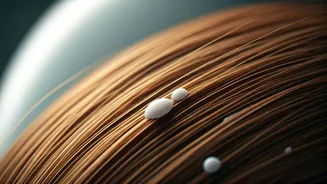
The scientific explanation behind moisture's benefit to hair lies in the structure of each individual hair strand. On the outermost layer of a hair shaft, there's a protective coating known as the cuticle. When hair is depleted of moisture, these cuticle scales tend to lift and separate, leaving the underlying hair shaft exposed, rough, and susceptible to damage. Hydration helps to flatten these cuticle scales, creating a smoother surface. This smoother surface not only reduces friction between hair strands, making them less likely to snag and break, but also imparts greater elasticity to the hair. Elasticity means the hair can bend and flex without snapping. Essentially, by keeping your hair moisturised, you equip it to withstand the rigors of daily life – from combing and styling to being tied up – preventing it from falling apart prematurely.
Perception vs. Reality
The common perception that moisture 'works' for hair growth often stems from a misunderstanding of what's actually happening. Hair naturally grows at a steady pace, typically around 1 to 1.5 cm each month. However, if the ends of your hair are constantly breaking off due to dryness or damage, this natural growth becomes imperceptible. When you introduce a consistent moisturizing routine, you drastically reduce breakage and split ends. As a result, your hair retains more of its length. This leads to the visual effect of your hair seeming to grow much faster, when in reality, you're simply preserving the length that was already being generated from the root. It's important to differentiate between true growth stimulation and effective length retention. Furthermore, 'moisture' in haircare isn't synonymous with 'oil'. True moisture often involves water, humectants like glycerin or aloe vera that attract water, conditioners that soften, and oils that then seal in that hydration. A balanced approach typically involves hydrating first, then sealing.
Signs of Dry Hair
When your hair is consistently lacking in moisture, it sends out clear signals that it needs attention. Pay close attention to these signs, as they indicate your hair is struggling to hold onto its growth rather than a lack of actual growth from the root. One of the most immediate indicators is a rough, dry texture to your hair; it feels coarse and brittle to the touch. You might also experience constant tangling, where your hair knots up easily, even when it hasn't been styled. The appearance of split ends cropping up prematurely is another red flag. Your hair may also look dull and lack its natural vibrancy and shine. Perhaps most concerningly, you might notice your hair snapping off while brushing or styling. These symptoms don't necessarily mean your hair isn't growing; they mean it's not strong enough to retain that growth effectively.
Simple Moisture Fixes
Achieving healthier, more retained hair length doesn't require an overly complex or time-consuming regimen. Simple, consistent practices are far more effective than chasing trendy hacks. A fundamental step is to always use a conditioner after shampooing your hair; this replenishes moisture lost during cleansing. If your hair consistently feels dry, consider incorporating a leave-in conditioner for added hydration throughout the day. Oils are valuable but should be used strategically to lock in moisture, not as a primary moisturizing agent. Applying oil to already dry hair without a hydrating base can be less effective. It's also crucial to avoid over-washing your hair, as this can strip it of its natural oils and moisture. Treat the ends of your hair with extra gentleness, as they are the oldest and most fragile part of the strand. Consistency in these basic steps is the most critical element for noticeable improvement.
Moisture's Limitations
While emphasizing the benefits of moisture is important, it's equally crucial to manage expectations and understand its limitations. Hydration is a powerful tool for hair health and retention, but it is not a miracle cure for all hair concerns. Moisture will not fundamentally alter the speed at which your hair grows from the root; that remains dictated by genetics and internal factors. It cannot correct hair loss caused by hormonal imbalances or reverse genetic conditions like baldness. You should also be wary of claims promising instantaneous or overnight results solely through hydration. The effects of improved moisture levels are cumulative and require consistent effort over time. Therefore, while embracing moisturizing practices is highly recommended for healthier, longer-looking hair, it's important to approach them with a realistic understanding of what they can and cannot achieve.
The Core Takeaway
The 'moisture theory' of hair growth is less about accelerating new growth and more about masterful retention. It's a simple yet profound concept: moisture doesn't spur your hair follicles to produce new strands any faster, but it strengthens your existing hair to the point where it can actually hold onto the length it naturally grows. This preservation of length is often perceived as faster growth, but the reality is that you're simply minimizing loss. This focus on reducing damage and maintaining hair health is often more impactful than trying to boost inherent growth rates. The most effective haircare doesn't need to be complicated or expensive; understanding and implementing basic practices, like ensuring your hair is adequately moisturized, can yield significant results. Instead of chasing unattainable growth acceleration, concentrate on damage reduction, maintaining overall hair health, and being consistently diligent with your routine. Your hair is already growing; the true art lies in ensuring it grows long enough for you to enjoy the results.