







How They Work
The primary distinction between induction and infrared cooktops lies in their heating mechanisms. Induction technology employs electromagnetic fields generated
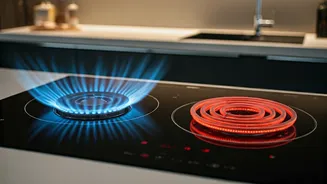
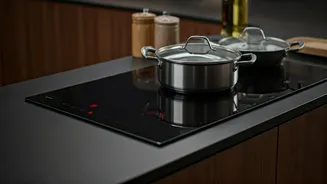
by a copper coil beneath the glass surface. This field directly energizes the metallic base of compatible cookware, producing heat within the pot or pan itself. Consequently, the cooktop surface remains relatively cool, only warming from residual heat transfer from the cookware. This direct heating method is highly energy-efficient, as minimal heat is lost to the surrounding environment. In stark contrast, infrared cooktops utilize a halogen lamp or heating element situated below the glass. This element heats the glass surface, which then radiates heat upwards to warm the cookware placed upon it. This method is analogous to traditional electric coil stoves but offers more uniform heat distribution. The entire surface becomes hot, and this heat is then transferred to the vessel and its contents. A significant practical consequence of these differing operational principles is that induction cooktops require specific magnetic cookware, while infrared cooktops are compatible with a much broader range of flat-bottomed cookware.
Cookware Compatibility
The choice of cookware presents the most significant practical divergence between induction and infrared cooktops, particularly within the context of an Indian kitchen. For induction cooktops, a strict rule applies: the cookware must possess a magnetic base. A simple test involves using a refrigerator magnet; if it adheres firmly to the pan's bottom, it's suitable for induction. Materials like cast iron, carbon steel, enamelled iron, and certain stainless steel variants with a magnetic core are compatible. However, many common Indian kitchen vessels, such as traditional thin aluminium pressure cookers, everyday aluminium pots, and lightweight aluminium kadhais, lack this magnetic property and will not function on an induction hob unless they have been retrofitted with an induction-compatible base. This often necessitates an investment in new cookware. Infrared cooktops, conversely, offer far greater flexibility. Because they heat the glass surface, which then transfers heat by contact, they work with a wide array of materials including aluminium, copper, glass, ceramic, and most stainless steel items, provided they have a flat bottom. This means you can typically continue using much of your existing cookware. A shared limitation for both types of cooktops, however, is their preference for flat-bottomed vessels. Traditional rounded-base kadhais, common in Indian cooking, can cause issues. On induction, the hob may not detect the cookware, failing to activate. On infrared, uneven heating can occur due to imperfect contact. For deep-frying or stir-frying in a kadhai, employing a heavy, flat-bottomed kadhai or a wok with a level base is recommended for both systems.
Cooking Performance Edge
When it comes to cooking performance, induction cooktops generally offer a superior experience, particularly for the nuanced demands of Indian cuisine. Their ability to heat cookware directly translates into significantly faster heat-up times. Whether it's bringing a pressure cooker to temperature rapidly, boiling water for rice, or preheating oil for a crucial tadka, induction excels in speed. Furthermore, induction provides remarkably precise temperature control. Adjustments to the electromagnetic field can be made almost instantaneously, allowing for swift transitions from high-heat sautéing to a gentle simmer, a critical factor in Indian cooking where precise heat management can differentiate a perfectly cooked dish from a burnt one. While infrared cooktops respond more slowly and retain heat in the surface for a period after the setting is reduced, making fine-tuning more challenging. Infrared does possess a slight advantage in even heating; its radiant heat transfer tends to distribute heat more uniformly across the entire base of the vessel. Induction, conversely, can sometimes create hot spots, concentrating heat more intensely at the centre of the pan. For quick tadka preparations, induction's responsiveness is beneficial, enabling precise temperature management. However, neither electric cooktop replicates the direct flame of a gas stove, which is essential for the authentic puffing of phulkas or rotis. While rotis can be cooked well on a tawa on both platforms, achieving the characteristic puff often requires practice and potential workarounds. Dishes like baingan bharta, which rely on smoky flavours from direct flame charring, are also challenging to replicate without resorting to alternative methods like oven grilling or the dhungar technique.
Efficiency, Safety, and Cost
Induction cooktops stand out for their exceptional energy efficiency, capable of transferring up to 90% of their energy directly to the cookware, thereby minimizing heat loss to the surroundings. While infrared cooktops are more efficient than older electric coil models, they still experience energy dissipation through the heated glass surface. Over time, this superior efficiency in induction models can lead to noticeable reductions in electricity bills. Safety is another prominent advantage for induction cooktops. Their surfaces remain cooler during operation, significantly reducing the risk of accidental burns, a crucial benefit in homes with children or elderly individuals. Infrared surfaces, however, stay hot for a considerable time after being switched off. Both induction and infrared offer enhanced safety compared to gas stoves, eliminating concerns about gas leaks or open flames. In terms of initial cost, infrared cooktops are typically more budget-friendly, with entry-level models available in India for around ₹1,500 to ₹2,500. Induction models generally start higher, from ₹2,000 to ₹3,500, with the added expense of potentially needing to purchase new, compatible cookware. Despite the higher upfront investment, the long-term energy savings offered by induction can compensate for the initial cost difference, making it a financially viable option for everyday family cooking over the span of a few years.
Making Your Choice
The decision between an induction and an infrared cooktop hinges on your specific kitchen habits and priorities. Opt for an induction cooktop if you predominantly use stainless steel or cast iron cookware, are willing to invest in induction-compatible pots and pans, prioritize rapid cooking and highly accurate temperature control, and value enhanced safety features in your home. Conversely, an infrared cooktop is the more suitable choice if you wish to continue using a diverse collection of existing cookware, including non-magnetic materials like aluminium, if you are operating on a more constrained budget, or if you prefer a simpler, more intuitive cooking experience that doesn't require constant checks for cookware compatibility. Ultimately, there isn't a single 'correct' answer, as both technologies represent significant improvements over older electric cooking methods and can serve an Indian kitchen effectively. Many experienced Indian home cooks find that after an initial adjustment period, they strongly prefer induction due to its speed and precise control. However, infrared remains a practical and adaptable option, especially for kitchens equipped with a wide array of cookware accumulated over many years. Understanding your own culinary needs and existing kitchen setup is key to making the most informed decision.