







A Resounding Return
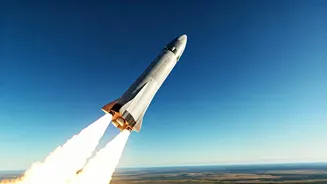
Firefly Aerospace's Alpha rocket has once again demonstrated its capability by successfully reaching Earth's orbit on its most recent launch. This significant
achievement follows a period marked by challenging incidents, specifically two explosive accidents in the preceding year. The launch, originating from Vandenberg Space Force Base in California on Tuesday, October 10th, at 6:01 p.m. EDT (2201 GMT), was a pivotal moment for the company. Dubbed the "Stairway to Seven" mission, it carried a payload of seven small satellites, destined for NASA's Educational Launch Activities Program (ELaNa) and the U.S. Space Force. This successful orbit insertion represents a critical milestone, showcasing Firefly Aerospace's resilience and their dedication to overcoming the technical hurdles encountered in their prior launch attempts. The company has diligently worked on refining the Alpha rocket and its associated launch infrastructure, incorporating advancements such as an updated engine design and a modified payload fairing. The successful completion of this mission serves as a strong validation of the engineering team's tireless efforts and unwavering commitment.
Lessons from Failure
The journey to this successful orbit wasn't without its trials for the Texas-based Firefly Aerospace. Today's mission, "Stairway to Seven," was the seventh flight for the Alpha rocket, but its history includes two significant setbacks in the past year. The first incident occurred in April during the "Message in a Booster" mission, where a technology-demonstrating satellite for Lockheed Martin could not be delivered to orbit due to an anomaly during stage separation. The second, more impactful failure happened in September when a first stage of the Alpha rocket exploded on the test stand during pre-launch preparations for "Stairway to Seven." This latter mishap caused substantial delays, forcing the company to dedicate months to investigating the root cause and preparing another booster for flight. The investigation into the test-stand explosion ultimately pinpointed a "process error during stage one integration that resulted in a minute hydrocarbon contamination," as stated in a Firefly update in November. Crucially, this finding absolved the rocket's design, clearing the path for its return to the launch pad. Consequently, the "Stairway to Seven" mission was strategically reframed as a critical test flight, with a primary focus on achieving "nominal first and second stage performance," as outlined in the mission's description.
Mission Execution
The "Stairway to Seven" mission commenced its ascent on March 11th from Space Launch Complex-2 at Vandenberg Space Force Base in California, with liftoff precisely at 8:50 p.m. ET (0050 GMT on March 12). Approximately 2 minutes and 40 seconds into the flight, the Alpha rocket executed a flawless first-stage separation, releasing its main booster. The upper stage then continued its journey, propelling the payload towards its orbital destination. Roughly 30 seconds after the stage separation, the fairing was successfully ejected. The rocket's upper-stage engine performed nominally, cutting off its burn about 8 minutes after liftoff. This sequence culminated in the Alpha rocket achieving its planned orbit, positioning itself 151 miles (243 kilometers) above the Earth. Following the flight, Firefly celebrated the "Mission success! Alpha Flight 7 achieved nominal performance and validated key systems ahead of our Block II configuration upgrade. This test flight also delivered a demonstrator payload for @LockheedMartin Congratulations to the entire Stairway to Seven team!" The company has announced plans to retire the Alpha Block I configuration, having successfully climbed the "Stairway to Seven," as they advance towards their Block II upgrades.
Future Enhancements
Beyond simply revalidating its capabilities, the seventh launch of the Alpha rocket was instrumental in "test[ing] and validat[ing] key systems ahead of Firefly’s Block II configuration," which is slated to debut on Flight 8. The upcoming Alpha Block II variant will be an enhanced version of its predecessor, standing approximately 7 feet (2.13 meters) taller than the current 96.7-foot-tall (29.6-m) model. This next iteration will boast upgraded avionics and power systems, alongside improved thermal protection measures. This successful launch represents a significant stride forward for Firefly Aerospace, a company that has demonstrated excellence in various facets of its space ventures. Notably, their uncrewed Blue Ghost moon lander achieved a significant feat last year by becoming the first private spacecraft to successfully complete a mission on the lunar surface. However, the Alpha rocket's orbital success rate has been more measured, with only three successful orbital launch attempts out of its seven total attempts prior to this mission. This latest achievement, however, provides a strong foundation for future missions and the development of more advanced launch vehicles.