







Orbital Compute Ambitions
Following a successful $5 million seed funding round, TakeMe2Space, an innovative Indian startup, is now setting its sights on a substantial $55 million fundraising
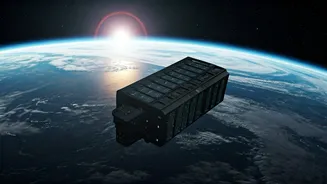
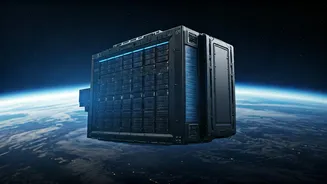
goal. This capital infusion is intended to facilitate the development and deployment of a 50-kilowatt data center in orbit. The company's founder, Ronak Kumar Samantray, articulated that a primary objective is to establish a global presence in the orbital data center market. He highlighted the significance of the 50- to 100-kilowatt compute scale, identifying it as a foundational element for future, much larger gigawatt-scale orbital data centers. This strategic focus positions TakeMe2Space to capitalize on the growing demand for decentralized computing power beyond Earth's atmosphere.
Paving the Way
Ronak Kumar Samantray, the visionary behind TakeMe2Space, brings a wealth of experience from his previous venture, NowFloats Technologies, which was acquired by Reliance Industries in 2019. Before embarking on the TakeMe2Space journey in late 2024, Samantray and his team conducted crucial spaceflight testing of a novel material designed to shield GPUs from the harsh effects of solar radiation. This foundational work directly informed their subsequent satellite development. Their inaugural satellite, launched in December 2024 aboard India's Polar Satellite Launch Vehicle (PSLV), was a one-unit cubesat named My Orbital Infrastructure-Tech Demonstration. This mission provided vital flight heritage for the startup's onboard computer systems, edge processors, and attitude determination and control systems, even while attached to the PSLV's fourth stage.
Phased Deployment Strategy
TakeMe2Space is implementing a carefully orchestrated, multi-phase approach to building its orbital infrastructure. The next significant step involves the launch of a six-unit cubesat in October, scheduled to ride aboard a SpaceX Falcon 9 rideshare mission. This satellite will feature an Nvidia Jetson module, enabling customers to test their AI models in orbit by uploading data and issuing commands. Currently, clients are evaluating these AI models using a physical twin of the cubesat on Earth. Looking further ahead, a 2027 mission, bolstered by funding from their recent seed round, will deploy a constellation of four satellites, each weighing approximately 100 kilograms. These satellites will be equipped with optical inter-satellite links to facilitate seamless data sharing among themselves, marking a crucial step towards a network of interconnected orbital computing resources.
Market Opportunities
While actively developing its space-based technological capabilities, TakeMe2Space is also diligently assessing the burgeoning market for on-orbit computation and data storage. Samantray has identified agriculture and insurance sectors as prime early adopters, given their pressing need for sophisticated inference engines capable of rapidly analyzing Earth-observation data to derive actionable insights. Moreover, there's a growing demand for secure, in-orbit data storage solutions. This is partly driven by the recognition that terrestrial data centers, despite their sophistication, are susceptible to disruptions. To address this, TakeMe2Space satellites are designed to offer a substantial 100 terabytes of storage capacity, providing a robust backup for mission-critical data.
Vertical Integration Advantages
A cornerstone of TakeMe2Space's strategy for cost-efficiency and control lies in its commitment to vertical integration. The company designs and manufactures nearly all components that will fly on their satellites, with the exception of solar cells and propulsion systems. This comprehensive in-house approach significantly reduces the manufacturing costs associated with each satellite. Samantray's vision for space-based computing infrastructure began to solidify around 2021, stemming from a straightforward yet profound idea: as humanity evolves into a spacefaring species, a robust and expansive compute infrastructure will be an indispensable requirement. By 2029 or 2030, the startup anticipates that reduced launch expenses will further enhance the economic viability of orbital data centers, encouraging clients to utilize these facilities for large-scale AI model training.