






Groundbreaking Dual Imaging
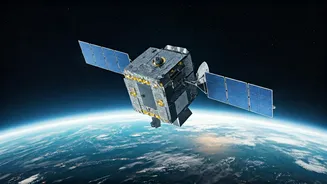
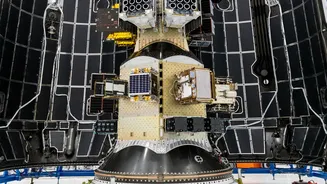
In a significant milestone for India's space endeavors, the startup GalaxEye has successfully deployed its inaugural satellite, named Drishti, into orbit
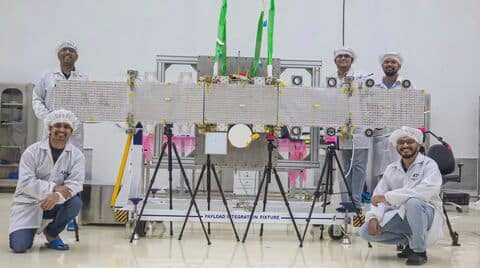
aboard a SpaceX rocket. This launch positions GalaxEye among a select group of global entities capable of operating a sensor platform that synergizes both optical and synthetic aperture radar (SAR) imaging functionalities within a singular spacecraft. The Drishti satellite carries an integrated sensor suite, a testament to the company's innovative Opto-SAR technology. Unlike conventional approaches that necessitate data fusion from disparate satellite missions, Drishti consolidates these two distinct imaging modalities—a traditional optical camera and an advanced SAR instrument—onto one compact platform. GalaxEye's founding vision centered on delivering persistent, high-resolution Earth observation capabilities that remain unfazed by adverse atmospheric conditions or the absence of daylight, and Drishti serves as the crucial proof-of-concept for this ambitious objective.
Overcoming Imaging Limits
Optical imagery offers remarkably sharp and easily interpretable visuals, but its utility is severely hampered by cloud cover and darkness, rendering it unreliable for continuous monitoring tasks. Synthetic Aperture Radar (SAR) technology, however, operates independently of these constraints. SAR functions by transmitting microwave pulses towards the Earth's surface and meticulously analyzing the characteristics of the returning signals. This fundamental difference means SAR can capture detailed imagery regardless of weather conditions or the time of day. The true innovation lies in GalaxEye's integration of both optical and SAR capabilities into a single satellite. This fusion eliminates the delays inherent in traditional methods, where analysts often must wait for clear optical views or laboriously cross-reference data from separate radar and optical archives captured at different times. This consolidated approach is particularly transformative for applications demanding unwavering coverage, such as coastal surveillance, effective disaster response coordination, precision agricultural monitoring, and critical defense reconnaissance, offering a solution that doesn't force users to compromise between image clarity and all-weather operational readiness.
Engineering the Integration
The technical feat accomplished by GalaxEye with the Drishti satellite lies in the intricate engineering challenge of integrating two distinct sensor payloads—each with its own unique aperture geometry, power demands, and data transmission requirements—into a single, compact satellite bus. The process ensures that the operational capabilities of one system do not adversely affect the performance of the other. SAR instruments are remarkable in their ability to generate two-dimensional images by processing the subtle Doppler shifts in the return signals as the satellite traverses its orbital path. This method effectively synthesizes a large antenna aperture from a physically smaller one, resulting in imagery that maintains consistent geometric accuracy, irrespective of solar illumination. This makes SAR an ideal complement to electro-optical sensors, which rely on reflected sunlight for image formation. While specific resolution details for both the optical and SAR channels, as well as the satellite's precise orbital altitude, have not yet been publicly disclosed, the initial on-orbit commissioning phase will provide the first independent verification of its performance.
Market Position and Future
GalaxEye's combined optical and radar offering, dubbed Opto-SAR technology, promises clear visual data alongside robust all-weather capabilities. Public disclosures have not specified whether the data streams are fused onboard the satellite or processed separately after downlink, a detail that will influence the system's overall efficiency. This launch places GalaxEye within a competitive commercial SAR market, which has seen substantial investment. Established players like Capella Space, ICEYE, and Synspective operate dedicated SAR constellations, while Planet Labs leads in optical small-satellite imaging. A platform that natively integrates both imaging types occupies a distinct niche. However, the ultimate measure of its success will be whether its data quality can rival that of specialized single-mode satellites. This development mirrors broader trends in space agency infrastructure evolution, with entities like the U.S. Space Force transitioning from legacy sensor systems to more advanced alternatives.
Next Steps and Validation
The immediate priority for GalaxEye following the successful launch of Drishti is the comprehensive on-orbit commissioning process. This critical phase involves activating both sensor channels, meticulously calibrating their geometric and radiometric performance, and confirming that the integrated system yields co-registered imagery of operationally relevant quality. The results from this commissioning phase will serve as the primary objective benchmark, determining whether the single-platform approach can indeed match or surpass the capabilities of separate, specialized satellites that rely on post-acquisition data fusion. Should Drishti's performance align with GalaxEye's design specifications, the company is anticipated to proceed with the development of a follow-on constellation. Such an expansion would significantly enhance revisit frequency, a key metric for the commercial viability of time-sensitive Earth observation applications.