


A Surprising Encounter
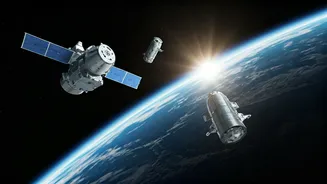
The remarkable event involved two commercial spacecraft that completed a surprising rendezvous in Earth's orbit, demonstrating capabilities that could
be critical for future satellite servicing ventures. This accomplishment was achieved through a joint effort between Starfish Space and Impulse Space, as part of a mission called Remora. Impulse Space's Mira orbital transfer vehicle, about the size of a dishwasher, utilized Starfish software to get within a mere 4,100 feet (1,250 meters) of another Mira. This served as a key demonstration of autonomous rendezvous and proximity operations (RPO) technology. This mission marks a significant achievement in space technology, showcasing the potential for enhanced efficiency and versatility in space operations. The successful rendezvous indicates a major milestone for Starfish, giving the company confidence as it prepares for its first Otter launches the following year.
The Remora Mission
The Remora mission, a collaborative venture between Starfish Space and Impulse Space, was crucial in validating their distinctive strategy for autonomous rendezvous and proximity operations in orbit. Developed in just nine months, the modified Mira launched in January 2025 on SpaceX's Transporter 12 rideshare mission, which delivered 131 payloads to LEO. This marked the second Mira to reach orbit, a testament to the ambitious LEO Express 2 mission. The Mira performed several precision engine burns to highlight the capabilities of its propulsion system. The mission's success provides a major milestone for Starfish, giving it confidence as it moves toward the first Otter launches. The achievement showcased the capability of bringing the mission from concept to execution quickly and delivering versatile, complex operations.
Otter's Capabilities Unveiled
The capabilities demonstrated during Remora were not entirely new. Prior to this, a precursor mission named Otter Pup 1 launched on SpaceX's Transporter 8 mission in June 2023. Otter is a versatile vehicle developed by Starfish Space to provide diverse satellite-servicing functions, including inspection, refueling, repair, and the de-orbiting of defunct or malfunctioning spacecraft. Starfish outfitted a Mira with a single, lightweight camera and the core guidance, navigation, and control (GNC) software suite — two programs called Cetacean and Cephalopod. The software was run on a peripheral flight computer. In a related event, Otter Pup 1 was originally slated to rendezvous with the space tug that launched it into orbit, but an anomaly with the parent vehicle thwarted that plan. Starfish developed a solution by maneuvering Otter Pup 1 within 0.6 miles (1 km) of a different space tug.
Technological Demonstration
The Remora mission's success highlights the technological advancements in autonomous rendezvous and proximity operations. The close approach occurred in late October over several hours. Mira chronicled the operation with its onboard camera, with photos from Impulse and Starfish showcasing the target Mira at distances of 6.2 miles (10 kilometers), 4 miles (6.5 km), 1.2 miles (2 km), and 4,100 feet (1,250 m). The demonstration included the use of Starfish Space's software for navigation. The successful operation highlights the potential of the approach. As Eric Romo, President and Chief Operating Officer of Impulse Space, stated, the team is capable of executing quickly and delivering versatile, complex operations. This RPO mission has the potential to enhance future space operations.