





Cabbage's Culinary Challenge
Cabbage often faces a poor reputation due to common culinary mishaps, leading to issues like an unpleasant sulfurous odor, a mushy consistency, or a bitter
taste, regardless of the cooking technique employed. These frustrations stem from a misunderstanding of how different heat applications, particularly the presence or absence of water, influence the vegetable's inherent properties. Boiling can result in limp and aromatic dishes, while stir-frying might lead to scorching before tenderness is achieved. Roasting, though promising visually with browning, can leave the interior unpleasantly crunchy. The key to overcoming these challenges lies not in finding a single 'correct' method, but in understanding the science behind how heat and water interact with cabbage's compounds to alter its flavor, texture, and aroma, thereby enabling cooks to choose the optimal approach for desired outcomes every time.
Testing the Cooking Spectrum
To demystify cabbage's behavior, a series of controlled experiments were conducted, utilizing 100-gram portions of green cabbage for each test, a widely accessible variety. The cooking methods and durations were selected based on common culinary practices across various cuisines. Pressure cooking, mimicking Indian and Eastern European techniques, involved 5 minutes in a sealed, moist environment. Boiling allowed for time-based observations at 1, 2, 5, 10, and 20 minutes to track flavor and texture changes in actively boiling water. Steaming was tested at identical intervals to directly compare its effects against boiling. Stir-frying utilized high heat with a tablespoon of oil for rapid cooking at 1, 2, and 5 minutes, aiming for browning and crunch. Finally, thick wedges were roasted at 500°F (260°C) with olive oil, salt, and pepper, flipped halfway through, to assess the impact of intense dry heat and high-temperature browning. These diverse methods provided a comprehensive comparison, highlighting how the application of heat and water profoundly alters the final cabbage dish.
Wet-Heat Transformations
Wet-heat methods, including pressure cooking, boiling, and steaming, fundamentally change cabbage by allowing its water-soluble flavor compounds to leach out. Pressure cooking for just 5 minutes results in a very soft, collapsed texture with a mild flavor, making it ideal for dishes where cabbage acts as a sponge for spices and sauces, like in many Indian preparations. Boiling cabbage over extended periods causes its flavor compounds to transfer into the cooking water, resulting in a blander vegetable and a more cabbage-forward broth. Prolonged boiling, especially beyond 20-30 minutes, can introduce a faint bitterness as sulfur compounds break down, a process that also contributes to the characteristic strong aroma. Steaming, often considered gentler, shows similar trends; as time increases, color dulls from bright green to olive, and sharp notes mellow into sweetness. While steaming for about 5 minutes yields a cooked yet vibrant cabbage, longer durations lead to a mushy texture. These methods are best suited for applications like soups, broths, and braises where the cooking liquid is integral to the final dish.
Dry-Heat Elaboration
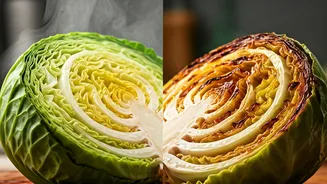
In contrast, dry-heat methods such as stir-frying and roasting concentrate cabbage's flavors and drive off moisture, leading to significantly different results. Stir-frying over high heat for brief periods of 1 to 5 minutes rapidly browns the cabbage, imparting savory notes and retaining a desirable crunch. Constant tossing is crucial to prevent scorching and ensure even cooking, although some variation in doneness can add textural complexity. Roasting, particularly with thick wedges at high temperatures (500°F; 260°C), achieves the most dramatic transformation. The intense dry heat caramelizes the exterior, producing deep, savory, almost umami-like flavors. This method excels when cabbage is the star of the dish and bold, complex flavors are desired. The science behind this lies in the Maillard reaction and caramelization, which occur under dry heat and high temperatures, creating new, desirable flavor compounds. While dry heat offers superior flavor development, it demands careful attention to prevent uneven cooking or burning, often necessitating a balance of high initial heat for browning followed by gentler cooking to ensure tenderness.
The Science Decoded
The contrasting outcomes between wet and dry cooking methods are rooted in cabbage's chemical composition, particularly its glucosinolates. These compounds are responsible for cabbage's pungent, sharp flavor and are water-soluble. When cooked with moisture, these compounds dissolve into the surrounding water, mellowing the cabbage's bite and revealing a subtle sweetness. However, as cooking continues, cell walls break down, and sulfurous compounds can form trisulfides, leading to mushiness, bitterness, and the pervasive odor associated with overcooked cabbage. Conversely, dry-heat techniques like stir-frying and roasting eliminate moisture, promoting browning reactions that build complex, savory flavors. High heat intensifies these processes but requires vigilance to manage heat distribution and prevent scorching or uneven cooking, as the absence of water means less temperature moderation. Understanding this interplay between heat, water, and cabbage's inherent compounds empowers cooks to intentionally manipulate the vegetable's characteristics for superior taste and texture.