
Satellite Contract Awarded
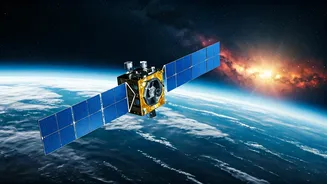
Terran Orbital has been chosen by Lockheed Martin to supply satellite buses for the Space Development Agency’s (SDA) Tranche 3 Tracking Layer. This agreement
signifies a significant step in enhancing the SDA's capabilities in space-based tracking. The Tranche 3 Tracking Layer is designed to improve the detection and tracking of hypersonic and ballistic missiles. This selection underscores the growing importance of advanced satellite technology in national security. The collaboration between Terran Orbital and Lockheed Martin will likely play a crucial role in strengthening the United States' defense capabilities in space. This project also boosts the broader space technology sector. It shows the continued investments in space-based defense systems and the increasing reliance on satellites for national security purposes. With this partnership, innovation and advancement in the space industry are anticipated, providing a boost to the growing space technology economy.
Propulsion System Expansion
Desert Works Propulsion is expanding its capacity for ion propulsion technology in the United States. This expansion comes through a domestic manufacturing partnership. It is coupled with the growth of their testing capabilities. Ion propulsion systems are pivotal in space exploration because they offer high fuel efficiency. This allows spacecraft to travel longer distances with less propellant compared to traditional chemical rockets. The expansion indicates the increasing focus on advanced propulsion technologies. It also highlights the U.S.'s commitment to staying at the forefront of space exploration. By expanding domestic manufacturing and testing facilities, Desert Works Propulsion is setting the stage for more ambitious space missions. Moreover, they are enhancing the country's strategic independence in the space arena. This growth is essential for future projects, pushing the boundaries of what's possible in space travel.
Microgravity Research Rideshare
Genesis has initiated a Microgravity Research Rideshare Program. This program is offering opportunities for experiments in microgravity to and from the Solar System. Experiments can be launched for as little as €6,000. This initiative facilitates accessible space research, opening doors for scientists, researchers, and entrepreneurs. The program aims to make space research more inclusive, providing cost-effective access to unique experimental conditions. Microgravity environments are perfect for a variety of research areas. These include materials science, biomedicine, and fundamental physics. With this program, the launch costs for scientific research are considerably lowered, promoting scientific discovery and development. This program opens a new era of space research by offering a cost-effective platform to investigate the effects of microgravity, fostering innovation across multiple scientific disciplines.
Mars Sample Return Mission
The Perseverance rover continues its scientific mission on Mars. However, there are some uncertainties about the Mars Sample Return mission. This mission's aim is to retrieve samples collected by Perseverance and bring them back to Earth. This mission is critical for understanding the history of Mars and the potential for past or present life. The challenges faced by the Mars Sample Return mission include complex logistics, technical hurdles, and budgetary considerations. Despite these uncertainties, the Perseverance rover continues to collect invaluable data. This data will contribute to future research. The outcome of the Mars Sample Return mission has the potential to transform our understanding of the Red Planet. Its successful execution would represent a major achievement in space exploration. It has the potential to answer fundamental questions about the possibility of life beyond Earth.