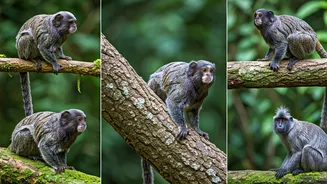

Pygmy Marmoset Marvel
The Pygmy Marmoset, residing in South America, holds the title of the world's smallest monkey. These tiny primates weigh a mere 100 grams, a remarkable
feat for a mammal. Their small size allows them to navigate the dense forest undergrowth with agility, where they feed on tree sap and insects. Pygmy Marmosets have specialized claws for clinging to tree trunks, an adaptation that assists them in their sap-feeding lifestyle. Their social structure revolves around small family groups, characterized by close bonds and cooperative parenting, ensuring the survival of their offspring. These groups mark their territories with scent markings, defending against intruders and maintaining their small, carefully managed territories, showcasing the intricate social and survival strategies of this miniature marvel.
Golden Snub-Nosed Monkey
Found in China, the Golden Snub-Nosed Monkey is a primate known for its vibrant gold fur and distinctive upturned nose. These monkeys thrive in the cold mountain forests, displaying a remarkable adaptation to harsh climates. They form social groups that can include several hundred individuals, creating a complex society based on cooperation and hierarchy. Their diet is primarily vegetarian, consuming leaves, fruits, and seeds. Golden Snub-Nosed Monkeys are considered vulnerable due to habitat loss and fragmentation, making them a focus for conservation efforts. They have developed a diverse repertoire of vocalizations, which they employ to communicate within their large social groups and coordinate activities, reflecting the intricate communication within their communities and illustrating their adaptation to their environment.
Bald Uakari’s Appearance
The Bald Uakari, native to Brazil, is distinguished by its bald head and striking red face. The vivid coloration is a sign of health, signifying good blood flow. Living in the flooded forests of the Amazon basin, the Uakari faces the challenges of seasonal flooding. The species lives in large social groups, with the size varying depending on food availability. They primarily consume fruits and seeds and play a critical role in seed dispersal. Their unique physical characteristics and habitat make them a striking example of adaptation. Due to habitat loss and hunting pressures, the Uakari is classified as vulnerable, which emphasizes the need for conservation initiatives. They showcase the adaptability necessary for surviving in a dynamic habitat, adding a key facet to the biodiversity of the Amazon.
The Proboscis Monkey
The Proboscis Monkey, native to Borneo, is famous for its large, pendulous nose found on adult males. These monkeys inhabit the mangrove and riverine forests, where they are skilled swimmers. Their diet is largely composed of leaves, seeds, and unripe fruits. The large nose of the males is believed to be a result of sexual selection, enhancing their appeal to females. The Proboscis Monkey lives in social groups led by a dominant male, a social structure seen commonly in primates. They face habitat loss from deforestation due to palm oil plantations and logging, impacting their survival. Conservation efforts focus on protecting their habitat. Their unique appearance and lifestyle serve as a fascinating example of adaptation to a particular environment.
Roloway Monkey of West Africa
The Roloway Monkey, a primate native to West Africa, is a small, striking primate known for its golden-brown fur and distinctive white beard. They inhabit the rainforests, where they feed primarily on fruits and insects. Roloway Monkeys are arboreal, spending most of their time in the trees, navigating with agility. They live in small family groups, showing complex social bonds and behaviors. The Roloway Monkey faces critical threats from habitat loss due to deforestation, as well as the bushmeat trade, which puts their species at a high risk. Conservationists have started various programs in an attempt to protect the remaining populations. Their status as an endangered species highlights the urgency of wildlife protection efforts. The preservation of this primate is crucial in sustaining the biodiversity of West African forests.
Celebes Crested Macaque
The Celebes Crested Macaque, found in Indonesia, stands out with its distinctive crest of hair on its head. These primates live in the rainforests of Sulawesi, their homes being unique. They are highly social, living in large groups, also known as troops, with complex social structures. Their diet consists of fruits, insects, and seeds, which are obtained through foraging. The Celebes Crested Macaque plays an important role in dispersing seeds. Habitat loss due to deforestation and human-wildlife conflict are threats to their survival. Conservation efforts focus on protecting their habitat and minimizing human impact. Their adaptability makes them an essential element of their ecosystem, showing the importance of protecting endangered primates.
Titi Monkey of South America
The Titi Monkey, residing in South America, is celebrated for its monogamous relationships and distinct vocalizations. These small primates live in the tropical rainforests of the Amazon, inhabiting trees. They display strong pair bonds, with a family group centered around a breeding pair and their offspring. Titi Monkeys primarily eat fruits, leaves, and insects. They are named for the distinctive territorial calls they make in the forest. Threats to the species include habitat destruction and hunting. Conservation efforts center on protecting the forests where they live. Titi Monkeys stand as an example of social behavior. They highlight the importance of conservation in sustaining biodiversity within the South American rainforests. Their unique family structures are a captivating aspect of primate social behavior.