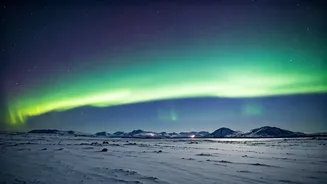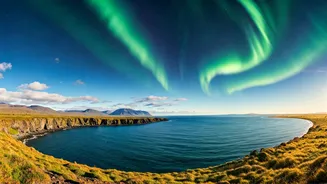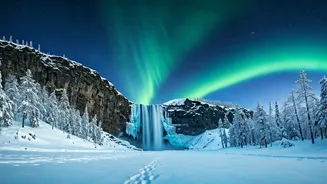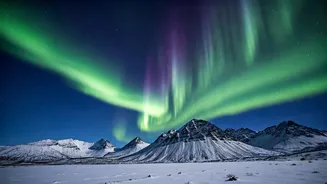






Time Your Trip Wisely
To boost your chances of seeing the aurora, especially after the solar maximum, plan your visit around the spring and fall equinoxes, typically in mid-to-late
March and September. During these periods, Earth's axial tilt and magnetic field configuration create more favorable conditions for solar wind particles to interact with our atmosphere, leading to increased geomagnetic activity. While the aurora's appearance is never guaranteed, timing your trip to these equinox periods significantly improves your odds of experiencing a robust display. This strategic timing is particularly valuable when chasing the lights outside of the sun's most active phase, ensuring you capitalize on windows of opportunity for more frequent or intense auroral events.
Seek Auroral Oval Zones
While solar maximum events can send the aurora to surprisingly southern latitudes, consistent viewing typically requires heading further north. The most reliable locations for spotting the Northern Lights are within the auroral oval, a band approximately 60 to 75 degrees north latitude. This zone encompasses prime viewing spots like Iceland, southern Greenland, Lapland, Yellowknife, and Fairbanks. Within this region, the aurora is more commonly visible without requiring extreme geomagnetic conditions. For instance, visiting Greenland and Iceland in late 2025 and early 2026 provided powerful, all-night displays even when forecasts seemed subdued, underscoring the advantage of being within this active band.
Allocate Ample Viewing Time
When you're dedicating your travels to experiencing the aurora borealis, it's crucial to give yourself sufficient time on the ground. Outside of solar maximum, planning for at least four to six nights in your chosen destination is highly recommended. This extended duration provides the necessary buffer for both geomagnetic activity to align with clear skies—essential for any aurora sighting—and to account for potential travel disruptions like flight delays or cancellations. My personal preference for significant aurora trips, especially during equinox periods, is to aim for a minimum of six nights. This allows for not only capturing the lights but also enjoying the journey to remote locations like Greenland or Churchill, Canada, without feeling rushed.
Choose Aurora-Friendly Stays
A smart strategy for aurora enthusiasts is to select accommodations that are inherently suited for nighttime sky-watching. Opting for lodging in northern locales that are far from light pollution, and ideally offer direct viewing opportunities from your room or a nearby porch, can be a game-changer. The aurora can appear at any hour, and being immediately ready to witness it, perhaps alerted by an app or a pre-set alarm, is key. Hotels like Hotel Arctic in Ilulissat, Greenland, or Borealis Basecamp near Fairbanks, Alaska, with their clear-walled igloos or dedicated wake-up calls for aurora sightings, exemplify this approach. This convenience is especially beneficial as the most active viewing hours often fall between 10 p.m. and 2 a.m. local time, or even later in places like Alaska, making immediate access paramount.
Consider a Guided Tour
Engaging a local guide is one of the most effective methods to significantly improve your chances of seeing the Northern Lights. These experts possess invaluable knowledge of prime viewing locations and the most opportune times for aurora sightings within specific regions. A guided tour eliminates much of the complexity involved in aurora forecasting, freeing you from the need to decipher technical terms like Kp, Bz, and solar wind speed. While understanding these concepts can enhance your personal aurora-hunting skills, a tour offers immediate access to the experience. For those seeking to deepen their knowledge, resources from aurora experts or in-person workshops can be beneficial, but for immediate success, a guided expedition is hard to beat.