





V3's Impressive Upgrades
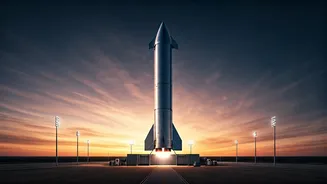
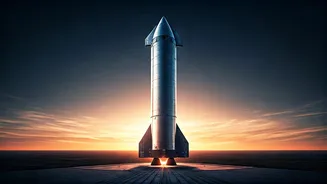
The latest iteration, Starship V3, brings a suite of enhancements designed to elevate its capabilities significantly. Powering this marvel is the V3 Raptor
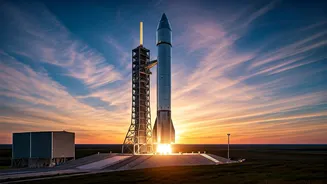
engine, boasting increased output compared to its predecessors. The launch pad itself has also seen modifications, featuring faster fueling systems and redesigned "chopsticks" for booster recovery. These combined advancements are pivotal for unlocking Starship's full potential, including rapid reusability, in-orbit refueling, deploying Starlink satellites, establishing orbital data centers, and ultimately, enabling human and cargo transport to the Moon and Mars. While the core mission profile remains similar to previous flights, these upgrades represent a substantial leap forward in the pursuit of interplanetary travel and advanced space infrastructure.
Mission Objectives Detailed
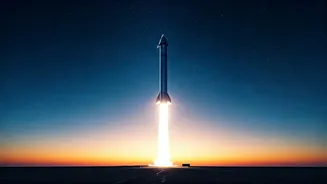
This upcoming flight test will see Starship V3 embark on a suborbital trajectory, heading eastward from its launch site. Approximately 17.5 minutes post-liftoff, the spacecraft is scheduled to begin deploying 22 simulated Starlink V2 satellites. This satellite deployment phase is expected to conclude about 10 minutes later. Intriguingly, the final two dummy satellites will be equipped with cameras to capture imagery of Ship's heat shield. This data is invaluable for refining the thermal protection systems for future missions. Furthermore, Ship will relight one of its six Raptor engines while in space, a critical maneuver for operational flights. If all proceeds as planned, the Ship upper stage is slated for a splashdown in the Indian Ocean around 65 minutes after launch. The Super Heavy booster, on the other hand, will execute a controlled soft splashdown in the Gulf of Mexico approximately seven minutes after liftoff. Notably, due to the significant redesign of this vehicle, the booster will not attempt its characteristic return-to-launch-site recovery maneuver for this test.
Anticipation and Innovations
The excitement surrounding this particular flight test, designated Flight 12, is palpable, largely due to the extensive upgrades making their debut. Starship has not flown since October 2025, a previous test flight that concluded successfully. The Starship V3 represents a significant evolution, incorporating numerous improvements over its earlier versions. The Super Heavy first stage now features three enhanced grid fins, which are 50% larger and considerably stronger than their predecessors. These fins are crucial for steering the booster during its descent for recovery and reuse. They've been strategically repositioned and redesigned with new catch points to facilitate lift and recovery operations, while also being lowered to mitigate heat exposure from the Starship's engines during the hot-staging process. Other key modifications to the Super Heavy include the integration of the hot stage – the section connecting the booster to the upper stage – directly into the booster, eliminating the need for it to be discarded mid-flight. The fuel transfer tube, responsible for delivering cryogenic fuel to the 33 Raptor engines, has undergone a complete redesign, now boasting a size comparable to a Falcon 9 first stage. This innovation ensures all 33 engines can ignite simultaneously, enabling faster and more reliable flip maneuvers.
Ship Upper Stage Enhancements
The Ship upper stage has also undergone substantial modifications for the V3 iteration. A complete redesign of its propulsion system allows for a new Raptor engine startup sequence, increases propellant tank capacity, and enhances the reaction control system responsible for in-flight steering. These propulsion updates also contribute to reducing contained volumes in the aft section of the vehicle, minimizing the risk of propellant leaks. Furthermore, the new upper stage is equipped with propellant feed connections, a critical feature for supporting the future capability of in-orbit fuel transfer – a maneuver that will be essential for deep-space missions. These collective improvements across both the Super Heavy booster and the Ship upper stage underscore SpaceX's relentless pursuit of a fully reusable and highly capable launch system poised to revolutionize space exploration.