
Comet's Grand Appearance
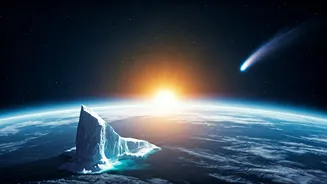
In the year 2026, astronomers and stargazers are eagerly anticipating the arrival of Comet C/2025 R3 (PanSTARRS). There's significant anticipation that
this comet will become a 'great comet', a term reserved for comets that are exceptionally bright and spectacular. Such comets are rare and create an unforgettable visual experience in the night sky. The brilliance of a great comet is determined by several factors, including its size, the composition of its nucleus, and its proximity to the Sun and Earth. If Comet C/2025 R3 (PanSTARRS) lives up to its expectations, it will offer a remarkable celestial display, potentially visible with the naked eye and providing a unique opportunity for both amateur and professional astronomers to study a pristine cosmic object. The comet's appearance will also bring valuable scientific research opportunities, helping scientists understand the formation and evolution of our solar system.
Meteor Shower Timing
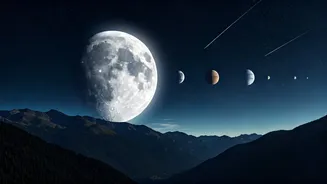
Another prominent event in 2026 will be the peak of one of the year's best meteor showers. Unfortunately, the timing of this celestial display coincides with conditions that might diminish its visibility. The exact date and the radiant point of the meteor shower were not mentioned in the context, but the article stated it would be during a less-than-ideal viewing window. This situation may involve a bright Moon or unfavorable weather conditions that could obscure the fainter meteors, reducing the number of shooting stars visible to the casual observer. Despite the challenges, dedicated meteor enthusiasts will likely find ways to maximize their viewing opportunities. Observing meteor showers requires patience, dark skies, and ideally, a location far from city lights. The best viewing times are usually after midnight, when the Earth's rotation has positioned observers in the direct path of the meteor stream. Even with less-than-perfect conditions, the chance to witness a meteor shower is always a treat.
Exoplanet Discovery
The realm of exoplanets also features in 2026, with the detection of a rare 'free-floating' exoplanet, one that is not gravitationally bound to a star. This discovery is particularly significant because such planets are difficult to find, as they don't emit or reflect much light, making them nearly invisible with standard observation techniques. The exoplanet was found 10,000 light-years away from Earth, highlighting the immense distances involved in astronomical research. These free-floating planets are believed to have been ejected from their star systems through gravitational interactions or other disruptive events. Their presence challenges current models of planet formation and raises questions about how frequently these rogue planets may populate our galaxy. This discovery offers valuable insights into the diversity of planetary systems, even though the specifics of the discovery method and the planet's characteristics were not mentioned in the context.
Auroras: Northern Lights
Auroras, or the Northern Lights, also have their place in the 2026 astronomical narrative. While not specifically tied to the timeline, the frequency and intensity of auroral displays are heavily influenced by solar activity. 2026 could see an increase in auroral activity, which would result in more spectacular displays in the night sky in the areas where the auroras are visible. Solar flares and coronal mass ejections (CMEs) from the sun are the primary drivers of auroras. These events release charged particles into space, which interact with Earth's magnetic field and atmosphere. The interaction between solar particles and the gases in our atmosphere creates the breathtaking displays of light that we know as auroras. To witness an aurora, one must be in a location with minimal light pollution and a clear view of the northern or southern horizon, depending on the hemisphere. Auroral displays can range from faint glows to dramatic curtains of light that dance across the sky.