






Lunar Night's Chilling Threat
Venture to the Moon's surface, and you'll encounter an environment far more hostile than Earth's arctic extremes. During the lunar night, temperatures
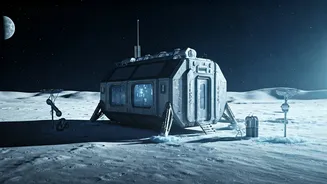
plummet to an astonishing -330 degrees Fahrenheit, a frigid period that persists for a full two weeks each month. This intense cold presents a formidable obstacle for both robotic probes and future crewed missions aiming for lunar landings. The extreme cryogenic conditions can cripple delicate electronics, causing soldered joints to fracture and batteries to cease functioning. As nations and private entities increasingly set their sights on lunar exploration, understanding and overcoming the perils of this deep freeze is paramount, especially for NASA's ambitious plans to establish a human presence on the Moon, particularly at its south pole where prolonged darkness is a characteristic feature.
Engineering for Extreme Survival
At the Goddard Space Flight Center, a dedicated team is rigorously testing a pioneering piece of equipment within a specialized thermal vacuum chamber. This chamber simulates the Moon's volatile temperature swings, oscillating between a searing 300 degrees Fahrenheit and the extreme cold of -330 degrees Fahrenheit. These cycles are meticulously designed to mirror the dramatic temperature fluctuations expected at the lunar south pole, a region targeted for potential astronaut landings as early as 2028. The instrument under scrutiny, known as the Lunar Environment Monitoring Station (LEMS), is engineered to withstand these punishing conditions. Initial test outcomes suggest LEMS is poised to become the inaugural U.S. payload capable of surviving an entire lunar polar night, marking a significant achievement in NASA's objective to establish a permanent base in this challenging lunar territory.
LEMS: A Crucial Moon Listener
The LEMS device represents a vital component of the Artemis program, designed to monitor lunar seismic activity for up to two years. This suitcase-sized apparatus is tasked with continuously listening for moonquakes and impacts from meteoroids, not only at the south pole but across the entire lunar surface. Contrary to some assumptions, the Moon remains a geologically active body, exhibiting seismic tremors despite lacking the plate tectonics characteristic of Earth. Historical data from Apollo missions, over five decades ago, indicated the presence of deep and shallow quakes, thermal events, and impacts. However, the instruments from that era had limited lifespans and provided an incomplete understanding of the Moon's internal structure. The enhanced data anticipated from LEMS is indispensable for NASA to confidently construct a human outpost, especially if the polar region proves to be more seismically active than currently predicted. Understanding the lunar interior is key, as past observations were largely confined to the near side of the Moon.
Innovative Power and Insulation
Unlike many previous long-duration space missions that relied on radioisotope thermoelectric generators for heat and power, LEMS employs a more sustainable approach. These generators, while potent, utilize scarce fuel, add complexity, and necessitate extensive safety reviews. LEMS, by contrast, is designed to operate using only solar energy, batteries, and advanced insulation. This design philosophy, if successful, could serve as a replicable model for future surface equipment, enabling faster and simpler deployment. The 66-pound LEMS unit is engineered for single-person transport, with its perceived weight significantly reduced on the Moon's surface. Astronauts will install it by placing it in a trench and burying two sensors underground. Once oriented correctly, the system is designed to operate autonomously. The internal components, including the battery, computer, and other electronics, are shielded from the external temperature extremes, maintaining a stable internal environment between -22 and 86 degrees Fahrenheit. This crucial temperature regulation is achieved through an advanced thermal blanket, a proprietary material known as Insulated Multi-Layered Insulation (IMLI), developed in collaboration with a specialized company. Additionally, NASA has collaborated with partners to optimize the charging of its lithium-ion battery, ensuring its functionality even below -30 degrees Celsius, a critical threshold where battery performance degrades due to lithium plating.