





Cosmic Camaraderie Captured
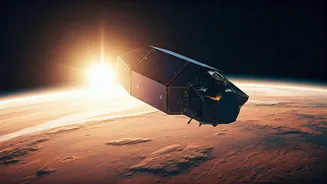
The Psyche spacecraft, on its ambitious mission to the 16 Psyche asteroid, recently executed a fascinating flyby of Mars. This close encounter, occurring
at a remarkable distance of just 2,864 miles (4,609 kilometers) from the Martian surface, yielded a treasure trove of images. These snapshots showcase the Red Planet in various phases and details, offering unique perspectives. One striking image depicts Mars as a bright crescent, a visual effect attributed to Psyche's approach angle relative to the sun and the planet. The multispectral imager, a key instrument aboard Psyche, proved instrumental in capturing these visuals. This instrument, capable of discerning both visible light and invisible near-infrared light, is crucial for analyzing the asteroid's composition upon arrival. The data gathered during this Mars transit is invaluable for calibrating these advanced cameras and testing image-processing software destined for asteroid exploration.
Martian Marvels Revealed
During its close pass, Psyche captured thousands of images, presenting us with diverse views of Mars. One particularly detailed image highlights the Martian southern polar cap, a vast expanse of water ice measuring over 430 miles (700 kilometers) in width. Another captivating image reveals intricate wind streaks etched across the Martian surface, extending up to 30 miles (50 km) long, set against a backdrop of craters averaging 30 miles (50 km) in diameter, primarily in the Syrtis Major region. Further enhancing our understanding, an enhanced-color view showcases the immense Huygens crater, a double-ringed impact structure spanning approximately 290 miles (470 km) in width. These images are not only visually stunning but also provide scientists with critical data for studying Martian geology and atmospheric dynamics, especially concerning light scattering caused by dust in the Martian atmosphere, which made the crescent appear brighter than anticipated.
Gravity Assist Maneuver
The strategic detour to Mars was not merely for photographic opportunities; it was a crucial maneuver known as a "gravity assist." This technique leverages the gravitational pull of celestial bodies, like planets, to alter a spacecraft's trajectory and gain speed, propelling it more efficiently towards its ultimate destination. NASA confirmed that this gravity assist provided Psyche with a significant velocity boost of 1,000 miles per hour and adjusted its orbital plane by approximately 1 degree relative to the sun. This maneuver was vital in setting the spacecraft on the correct course for its planned arrival at asteroid 16 Psyche in the summer of 2029. The precision of this operation was verified using the Doppler Shift effect, which allows ground control to precisely track the spacecraft's location based on changes in its radio signal wavelengths.
Paving the Way Forward
The successful Mars flyby marks a significant milestone for the Psyche mission, reinforcing confidence in the spacecraft's trajectory towards its namesake asteroid. The data collected, including the detailed Martian imagery and confirmation of the gravity assist's effectiveness, is invaluable for the mission's success. Instruments like the magnetometers, which may have detected a "bow shock" related to solar wind dynamics on Mars during the flyby, are also being tested and calibrated. Furthermore, Psyche is pioneering advanced communication technologies, including laser-beaming capabilities through its Deep Space Optical Communications (DSOC) software, which has demonstrated exceptional performance. This mission’s ultimate goal is to explore asteroid 16 Psyche, a celestial body theorized to be rich in precious metals, potentially holding immense economic value, though its true composition and worth will only be confirmed upon the probe's arrival in 2029.