





Recreating Primordial Matter
Scientists at the Large Hadron Collider (LHC) are achieving remarkable feats by recreating the universe's earliest conditions. Their groundbreaking experiments
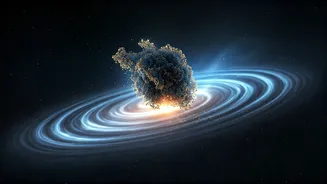
involve smashing particles, like protons and lead nuclei, together at speeds incredibly close to that of light. This intense collision process is designed to generate a state of matter known as quark-gluon plasma (QGP). For a fleeting moment after the Big Bang, the entire universe was thought to be composed of this QGP – a superheated, dense mixture of fundamental particles. While initially it was doubted that collisions involving smaller particles like protons could produce this plasma, recent observations have shown tantalizing evidence of its formation even in these less energetic events, alongside the expected QGP creation from heavy ion collisions. This suggests that the conditions necessary for QGP formation might be more prevalent than previously understood, opening new avenues for research into the universe's initial state.
Anisotropic Flow Patterns
A key indicator for identifying the presence and formation of quark-gluon plasma is a phenomenon called anisotropic flow. This means that the particles resulting from the collisions are not emitted randomly in all directions but exhibit a preference for certain directions. This 'preferred direction' is precisely what scientists measure and analyze. Researchers have observed that at intermediate speeds, this anisotropic flow is directly influenced by the composition of the particles involved. Specifically, baryons, which are made up of three quarks, tend to exhibit a stronger outward flow compared to mesons, which are composed of two quarks. This difference is believed to be linked to the fundamental process by which quarks coalesce to form larger particles. The more quarks a particle has, the greater the outward momentum it appears to gain during the expansion of the plasma, making baryons more 'flowy' than mesons.
ALICE Collaboration's Insights
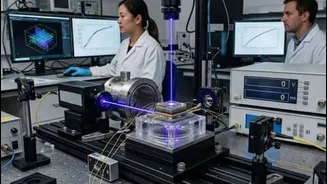
The ALICE (A Large Ion Collider Experiment) Collaboration has been instrumental in these discoveries. In their recent research, they meticulously measured the anisotropic flow patterns for various mesons and baryons produced in both proton-proton and proton-lead collisions. By carefully isolating and tracking particles that flowed together, the team successfully confirmed a crucial observation: even in these lighter collisions, the pattern mirrors what is seen in heavy ion collisions. This means that baryons emerge with a more pronounced flow, while mesons display a weaker flow at intermediate speeds. This finding is significant because it validates the hypothesis that an expanding system of quarks, characteristic of quark-gluon plasma, is indeed present even when the collision system itself is relatively small. This challenges previous assumptions and broadens the scope of where QGP-like phenomena can be studied.
Refining Cosmic Models
The data meticulously collected by the ALICE team was then compared against various theoretical models of quark-gluon plasma formation. The observed flow patterns remarkably aligned with models that explicitly account for the phenomenon of quark coalescence – the process by which quarks combine to form larger particles like baryons and mesons. However, models that did not incorporate this specific quark interaction struggled to accurately replicate the experimental results. This discrepancy highlights the critical role of quark coalescence in the early universe. Interestingly, even the most accurate models couldn't perfectly explain all the observed flow characteristics. The researchers noted certain lingering discrepancies, or 'wrinkles,' in the data. They believe that future experiments involving particle collisions with sizes intermediate to protons and lead, such as oxygen collisions, will be crucial in ironing out these remaining puzzles and providing a more complete picture.
Future Prospects and Origins
The ongoing research at the LHC, particularly with upcoming experiments involving oxygen collisions scheduled for 2025, promises to bridge the observational gap between smaller proton collisions and larger lead collisions. Spokesperson Kai Schweda of the ALICE experiment stated that these intermediary collisions are expected to yield profound new insights into the nature and evolutionary trajectory of quark-gluon plasma across a wider spectrum of collision systems. By studying these different scales, scientists aim to achieve an even deeper understanding of the extreme conditions that prevailed at the very genesis of our universe. Ultimately, these investigations push the boundaries of human knowledge, bringing us incrementally closer to unraveling the fundamental mysteries of the cosmos and its origins, as detailed in their recent publication in Nature Communications.