





Shadows on the Moon
As the moon enters its first quarter, half of its face is illuminated by sunlight, creating a stunning visual spectacle. This unique illumination accentuates
the dark basaltic plains known as lunar maria, which appear to darken the otherwise silvery surface. These vast expanses are not merely dark patches; they are remnants of ancient volcanic activity. Billions of years ago, colossal impacts left deep scars on the lunar crust, and molten lava flooded these wounds, eventually cooling and hardening into the maria we see today. For an enhanced view, even a simple pair of 10x50 binoculars can make these features appear more imposing, offering a glimpse into the moon's violent geological past.
Craters Along the Terminator
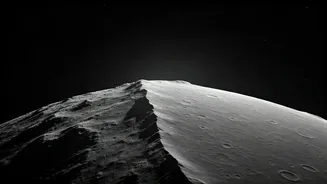
The jagged line separating the moon's illuminated and dark sides, known as the terminator, becomes a prime location for observing lunar features during the first quarter phase. A telescope with a 6-inch aperture can reveal intricate details of the moon's tumultuous history, particularly the numerous craters that dot this transitional zone. By directing your gaze about 10 degrees below the lunar equator, you'll encounter a trio of immense impact sites aligned along the terminator. The northernmost of these is Ptolemaeus, a massive walled plain spanning 95 miles (153 kilometers) in diameter, named after the renowned Greek mathematician and astronomer Claudius Ptolemaeus. Descending southward along the terminator, you'll find the smaller yet equally fascinating craters of Alphonsus and Arzachel. Continuing this sweep further south along the terminator reveals another captivating group: Purbach, Regiomontanus, and Walther. The mountainous rims of these craters cast dramatic shadows into their interiors, adding depth and visual intrigue to the lunar landscape.
Unique Lunar Shadows
Pay close attention to the basins of craters like Walther, Alphonsus, and Arzachel, and you might notice peculiar triangular shadows. These distinctive shapes are cast by the towering central peaks that rise from the depths of these impact structures. The interplay of sunlight and these prominent geological formations creates a mesmerizing effect, highlighting the sheer scale and power of the ancient impacts that sculpted these lunar features. Observing these unique shadow patterns offers a compelling visual testament to the dynamic processes that have shaped our celestial neighbor over eons, transforming the moon's surface into a canvas of cosmic history.
Celestial Neighbors
Tonight, as the first quarter moon graces the sky, it will be positioned near the stars of the Taurus constellation. Hours after reaching its quarter phase, its right half will be brightly lit by the sun, while the left will be shrouded in shadow. To the unaided eye, this half-lit appearance is quite striking. Look slightly to the moon's lower right, about 10 degrees away, and you'll see the soft glow of the Pleiades star cluster. Similarly, about the same distance to the moon's lower left, you can find the V-shaped Hyades cluster, which forms the face of Taurus, with the red star Aldebaran marking its eye. Further west, Jupiter will be visible as a steady point of light among the stars of Gemini. Closer to the horizon, the brilliant star Sirius in Canis Major will shine brightly, with Orion positioned between it and the moon, creating a beautiful celestial panorama.