



Distant Celestial Exploration
The James Webb Space Telescope (JWST) is an extraordinary technological feat, situated millions of miles from Earth. Far removed from the Sun's glare,
the JWST operates in a frigid environment, optimized for capturing the faintest signals of light. The telescope's primary objective is to study the origins of the universe and examine celestial bodies that were previously unreachable. The Webb telescope's vantage point allows it to observe the universe in infrared light, enabling it to penetrate cosmic dust clouds and observe objects that were formed shortly after the Big Bang. Its unique position and advanced technology give the JWST the capacity to peer further back in time than any other telescope, providing astronomers with an unprecedented window into the early universe.
Observing Ancient Stars
One of the key functions of the James Webb Space Telescope is to observe the most ancient stars, which provide clues about the universe's formative period. These primordial stars formed soon after the Big Bang, and their composition and characteristics hold essential details about how galaxies and stars were created. The Webb telescope's capacity to detect infrared light is crucial here. This type of light can penetrate the clouds of gas and dust that obscure these early stars, allowing astronomers to see them clearly. By analyzing the light coming from these old stars, scientists can measure their composition, temperature, and movement, helping them understand the conditions present in the early universe and how the earliest stars came to be.
Advanced Mirror Technology
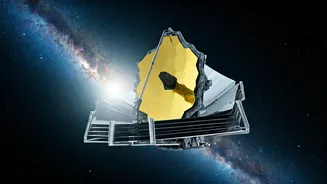
The James Webb Space Telescope's effectiveness is profoundly impacted by the innovative mirror technology employed in its design. These mirrors, among the lightest ever utilized, are a crucial element for collecting and focusing light from distant celestial objects. This design involves a large primary mirror consisting of several hexagonal segments that work in unison to gather light. Because the telescope needs to maintain its shape to accurately focus light, these mirrors are constructed with materials that do not expand or contract significantly with temperature fluctuations. The advanced mirror technology, integrated with infrared-sensitive detectors, is what gives the Webb telescope its unparalleled ability to observe the universe.
Fuel and Mission Lifespan
The mission duration of the James Webb Space Telescope is directly related to its fuel supply. Its journey will come to an end when it runs out of fuel. The telescope's precise orbit and orientation are maintained by onboard fuel that powers the thrusters, and the spacecraft can make slight adjustments as required. Given that the Webb telescope will not be able to refuel once it’s in space, its fuel supply dictates the duration of its mission. Once the fuel is completely depleted, the telescope won't be able to maneuver, and its operations will cease. The initial mission was designed to last for several years, providing scientists with ample time to conduct observations and gather essential data about the cosmos.
Unveiling Cosmic Secrets
The James Webb Space Telescope has the ability to uncover numerous secrets about the universe. It will probe into the early formation of galaxies, observe the development of planets and their atmospheres, and investigate the chemical composition of distant celestial bodies. Its capacity to peer through clouds of interstellar dust will allow astronomers to directly observe the processes of star formation and provide insights into the initial conditions of the universe. The JWST's data will advance our knowledge of the universe. With each new observation, the Webb telescope promises to unveil new discoveries and redefine our knowledge of the cosmos, furthering our understanding of how galaxies, stars, and planets formed and evolved.