






The Mighty Ostrich
Dominating the avian world as the largest bird, the ostrich is a quintessential example of terrestrial prowess. Native to Africa, this magnificent creature
has forgone the ability to fly, a trait compensated by its incredibly powerful legs. These sturdy limbs are not merely for support but are engineered for incredible speed, allowing the ostrich to outrun many predators. While its wings are too small for aerial locomotion, they play a crucial role in maintaining balance during its rapid sprints and are also integral to its elaborate courtship displays, demonstrating how even vestigial features can find new purposes in the grand theatre of nature. Its adaptations highlight a remarkable evolutionary divergence from its flying relatives, emphasizing ground-based survival.
Australia's Emu
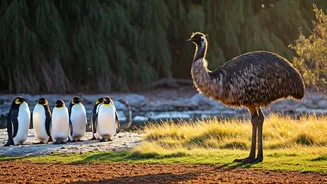
Hailing from the vast landscapes of Australia, the emu stands as another testament to avian terrestrial specialization. This substantial, flightless bird is equipped with exceptionally strong legs, enabling it to traverse considerable distances with remarkable swiftness. Unlike many birds whose wings are essential for flight, the emu's wings are significantly reduced and serve other, less obvious functions, perhaps aiding in thermoregulation or signaling. Its primary mode of locomotion is firmly rooted on the ground, where it navigates its environment with efficiency, showcasing a successful evolutionary path that prioritizes ground mobility over aerial pursuits, making it a distinctive inhabitant of its homeland.
New Zealand's Kiwi
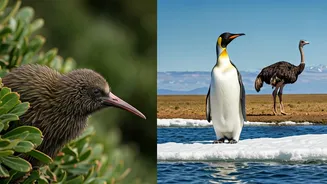
The enigmatic kiwi is a truly unique avian resident of New Zealand, celebrated for its distinct characteristics. This bird possesses loose, hair-like plumage that sets it apart from typical feathered birds, coupled with robust legs adapted for its ground-dwelling lifestyle. Its compact body and reduced wings underscore its terrestrial existence. The kiwi is predominantly found foraging on the forest floor, showcasing a profound evolutionary commitment to life on land. Its specialized adaptations make it a fascinating subject of study, illustrating how birds can evolve to fill niches far removed from arboreal or aerial environments, thriving instead within the rich ecosystems of the forest floor.
Aquatic Penguins
Penguins represent a fascinating evolutionary pivot, having traded the skies for the depths of the ocean. These flightless seabirds, predominantly found in the Southern Hemisphere, have transformed their wings into highly effective flippers, masterfully propelling them through water. Their physical structure is exquisitely adapted for aquatic life, featuring a streamlined body and dense bones that aid in diving. This specialization makes them unparalleled swimmers and divers, perfectly suited for the cold, marine environments they inhabit. Their journey from aerial ancestors to expert swimmers is a powerful example of adaptation driven by environmental pressures and the exploitation of available resources, showcasing a different pathway to avian success.
The Fierce Cassowary
Native to the lush rainforests of the Australo-Papuan region, the cassowary is a strikingly large and powerful flightless bird. It is characterized by its formidable legs, robust physique, and a lifestyle firmly entrenched on the forest floor. Although it lacks the ability to fly, its powerful legs and agility allow it to navigate the dense jungle with impressive skill. The cassowary's unique casque, or horn-like appendage on its head, adds to its distinctive appearance. It is a remarkable example of a bird adapted to thrive in challenging terrestrial habitats, showcasing how strength and ground-based mobility can be key survival strategies in dense, complex environments.
South America's Rhea
The rhea, a large flightless bird native to the open plains of South America, shares kinship with the ostrich and emu. It is exquisitely adapted for life in open country, relying on its speed and agility as primary defenses. Possessing long, slender legs and a relatively lightweight frame, the rhea is built for running rather than flying. Its evolutionary path has favored the development of terrestrial locomotion, allowing it to cover vast distances quickly and evade predators. This adaptation makes it a quintessential example of how birds can evolve to suit grassland environments, where swift movement on the ground is paramount for survival against threats.
Critically Endangered Kakapo
Hailing from New Zealand, the kakapo is a critically endangered flightless parrot that offers a unique perspective on avian evolution. Unlike most parrots that are arboreal and diurnal, the kakapo is nocturnal and strictly ground-dwelling. This unusual lifestyle, coupled with its inability to fly, makes it particularly vulnerable. Conservation efforts are crucial for its survival, highlighting the fragility of species that have undergone such significant evolutionary divergence. The kakapo's plight underscores the importance of preserving habitats and understanding the specific ecological needs of these rare, flightless birds, making it a symbol of conservation challenges and triumphs.