






Beyond Traditional Limits
The relentless demand for more data storage is pushing the boundaries of current technology. While hard disk drives (HDDs) are impressively reaching capacities
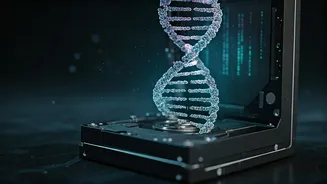
over 30 terabytes and employing efficiency boosts like helium, and solid-state drives (SSDs) gain popularity, a truly paradigm-shifting advancement is on the horizon: DNA. Not the living kind, but the helical molecule itself, repurposed as a storage medium. This innovative approach stems from research, notably from a University of Missouri team, that envisions transcribing digital information onto synthetic DNA strands. Early concepts involved intricate processes like 'branding' DNA with heated microstaples of varying lengths to represent data bits, akin to old punch cards. However, these initial stages faced significant hurdles, including prohibitively high transcription costs and the inability to modify data once written. The quest for a more practical and accessible DNA storage solution has been ongoing, seeking to overcome these initial limitations.
Viral Inspiration Unlocks Speed
A pivotal breakthrough in DNA data storage has emerged, drawing inspiration from the natural world's efficiency. Researchers have adopted a mechanism that mimics how viruses integrate their genetic material into host cells, a process known as viral ribosomal frameshifting. This ingenious approach allows for the direct writing of data onto a universal DNA template without requiring complex synthesis or enzymatic processing. This means the conversion of digital information into a DNA format is becoming significantly faster and more cost-effective. By sidestepping previous bottlenecks, this innovation opens up exciting possibilities for the widespread adoption of DNA-based storage solutions. The implications are vast, potentially leading to computers and data archival systems that operate on principles we've only previously encountered in science fiction, perhaps reminiscent of advanced biological interfaces.
Unmatched Data Density
The allure of DNA as a storage medium lies fundamentally in its staggering capacity. Compared to conventional hard drives, DNA offers an almost unimaginable density of information. A single gram of DNA can theoretically hold an astounding 215 million gigabytes of data. Researchers have demonstrated a data density of approximately 25 DNA bases per bit, where bases (G, A, T, C) are the fundamental building blocks. Considering a human genome contains about three billion base pairs, this translates to roughly 240 million bits, or about 30 megabytes, packed into an incredibly small molecular structure. When you think about the sheer volume of data that can be encoded within the minuscule space occupied by each cell in every organism, the cost-effectiveness of DNA storage becomes profoundly apparent. This molecular density far surpasses anything achievable with current magnetic or flash memory technologies.
Enhanced Functionality Potential
Beyond sheer storage density, DNA drives offer potential advantages in processing and computational capabilities. The University of Missouri team suggests that DNA drives could facilitate parallel data writing and rewriting, which would significantly accelerate operations that rely on this storage technology. Furthermore, this molecular medium could pave the way for novel computing architectures, such as fuzzy logic circuits. Unlike traditional binary computers that rely on absolute truths (0s and 1s), fuzzy logic allows for degrees of truth, enabling more nuanced and flexible information processing. This could lead to computers that are more adaptable and capable of handling complex, real-world data with greater sophistication. The potential for DNA to not only store vast amounts of data but also to influence how that data is processed represents a significant leap forward in computing.
Overcoming Current Hurdles
Despite its immense promise, DNA data storage still faces practical challenges that need to be addressed before widespread adoption. A primary concern is the process of retrieving and decoding the stored information. Current computing systems must effectively 'unzip' the data from the DNA molecules. While researchers are developing advanced tools, like a 'novel nanopore unzipping marker,' to enhance accuracy and efficiency, the identification and sequencing of these molecular data markers remain complex. Moreover, the current reading speeds are a significant bottleneck. Recent tests indicate a reading rate of only 10 bits per second, a stark contrast to the speeds offered by even the slowest conventional HDDs (80 MB/s) and SSDs (550 MB/s). However, ongoing research and continued development in sequencing and retrieval technologies are expected to improve these speeds, gradually bringing DNA drives closer to commercial viability.