





From Humble Beginnings
The journey of the beloved marshmallow Peep began in Lancaster, Pennsylvania, where the original marshmallow chick was a handcrafted delicacy, meticulously
piped by hand through pastry tubes. This artisanal approach defined its early existence. However, a significant shift occurred in 1953 when the Just Born company, established in Bethlehem, Pennsylvania, in 1932, acquired the Rodda Candy Company, the originator of the Peeps. A pivotal moment arrived in 1954 when Sam Born, a second-generation candy maker, introduced mechanization to the marshmallow-forming process. This innovation was revolutionary, drastically reducing the production time from an astonishing 27 hours per Peep to a mere six minutes. This efficiency upgrade was the catalyst that allowed for the widespread availability and enduring popularity of the candy we know today. The foundational design, though refined over time, has remained remarkably consistent, a testament to its initial appeal. For instance, the iconic wings present in early designs were removed in 1955 to achieve a sleeker silhouette, and the bunny shapes evolved from a profile view to a forward-facing stance. These subtle evolutionary changes have helped maintain the brand's visual identity while adapting to modern aesthetics and manufacturing capabilities.
The Sweet Transformation
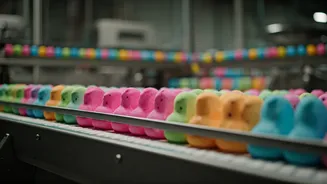
The production floor is a marvel of modern confectionery engineering, operating continuously from Monday through Friday, churning out an astounding 5.5 million Peeps each day, contributing to an annual total exceeding 2 billion units. This immense output is directly attributable to Born's groundbreaking automation. The process commences with vast quantities of sugar, which are meticulously mixed with vibrant food colorings in enormous tumblers. The day of the visit happened to be a 'yellow day,' highlighting the production of the classic yellow chick. However, depending on the manufacturing schedule, these mixers also produce Peeps in delightful shades of pink, blue, and lavender. Once the colored sugar is prepared, it is evenly spread across the beginning of an extensive conveyor belt. A specialized, patented piping machine then deposits the marshmallow mixture onto this sugar-coated surface, forming the characteristic shapes in groups of five. Following this initial shaping, the nascent Peeps enter an enclosed environment for a 'sugar bath,' a process that further coats them and ensures the desired texture. This stage is crucial for preparing them for the subsequent decorative steps.
Decorating with Precision
The decoration phase represents a significant technological leap in Peeps manufacturing. Historically, in the 1960s, the distinctive eyes of the Peeps were applied manually by a team of skilled workers using a stamping method. Today, this intricate task is accomplished by advanced machinery that precisely 'kisses' the top of each Peep, applying the eyes with remarkable accuracy. To guarantee uniformity and quality, these decorated Peeps undergo digital scanning. This rigorous inspection ensures that the eyes are positioned correctly, and any anomalies, such as cross-eyed specimens, are identified and subsequently recycled back into the production process. Following the eye application, any excess sugar remaining on the conveyor belt is efficiently removed and returned to the initial mixing stage, optimizing resource utilization. The now-completed Peeps then embark on a lengthy journey along another series of conveyor belts, a deliberate design choice to facilitate an extended cooling period before they reach the packaging area. This extended cooling is vital for maintaining their structural integrity and texture.
Packaging and Beyond
Upon reaching the packaging section, the Peeps continue through a quality control process where any imperfectly decorated items, identified during the scanning phase, are culled and recycled. The flawless Peeps are then carefully sorted into their designated groups of five and distributed across multiple, smaller conveyor belts. From these belts, they cascade gently into their individual cardboard containers. This precise sorting and filling ensure each package contains the correct number of treats. The filled containers are then automatically paired and subjected to a specialized packaging machine that wraps them for sale. This machinery is highly adaptable; depending on the desired package size and color, the wrapping can be swiftly swapped to match the product. The final stage involves the automated boxing of the packaged Peeps. Specialized machines with a series of robotic arms and levers meticulously fold the cardboard boxes and stack the packaged treats, preparing them for shipment. The facility is lined with vast towers of these boxed Peeps, all ready to be distributed nationwide. It is a point of immense pride for the company that every single Peep consumed in the United States originates from this singular factory.