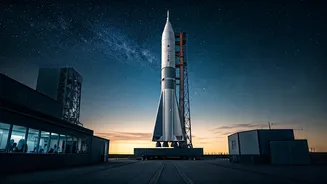








Artemis 2 Rocket's Grand Appearance
The monumental Artemis 2 moon rocket, poised for its groundbreaking lunar voyage, has recently been the subject of captivating imagery and considerable
attention. NASA's chief for human spaceflight was seen observing the colossal spacecraft, underscoring its importance. The sheer scale of the Artemis 2 rocket, designed to carry astronauts around the moon, makes it a dominant presence. Its proximity to other significant launches, such as the SpaceX Crew-12 mission, highlights the packed nature of current space endeavors. This juxtaposition of major missions emphasizes the rapid advancements and increasing activity within the space exploration sector, painting a picture of a bustling launchpad where different celestial objectives converge and coexist. The focus remains on the Artemis program's ambitious goal to return humans to the lunar surface, with Artemis 2 serving as a critical precursor mission.
Navigating a Crowded Launch Calendar
The launch schedule for space missions has become an intricate ballet, particularly with the Artemis 2 mission's progress coinciding with other high-profile events like the SpaceX Crew-12 launch. This delicate dance of timing illustrates the complex logistical planning required to manage multiple significant spaceflights simultaneously. The presence of the Artemis 2 rocket, a behemoth destined for lunar exploration, alongside missions ferrying astronauts to the International Space Station, showcases the diverse range of objectives within modern spaceflight. This crowded calendar also brings into focus the challenges and opportunities presented by international collaboration and competition. The report of a cosmonaut being removed from a SpaceX mission due to national security concerns further underscores the geopolitical undertones that can influence even the most scientifically driven endeavors. Such incidents remind us that the pursuit of space exploration is not solely a scientific endeavor but also one deeply intertwined with global politics and security considerations.
Broader Horizons in Space Exploration
Beyond the immediate focus on Artemis 2 and SpaceX's ongoing operations, the broader landscape of space exploration is teeming with activity and potential. The year 2026 is shaping up to be a landmark period, marked by a renewed push for lunar exploration and the development of advanced space telescopes. Global cooperation, alongside a healthy dose of competition, is expected to drive significant progress in these areas. The mention of private companies becoming increasingly involved in the race to the moon, paralleling the efforts of national space agencies, signals a transformative shift in how space missions are conceived and executed. This evolving dynamic suggests a future where both governmental and commercial entities play pivotal roles in expanding humanity's reach beyond Earth. Furthermore, the emergence of significant performance anomalies in rocket launches, such as the Vulcan Centaur's recent issue, serves as a reminder of the inherent risks and complexities involved in venturing into space, underscoring the continuous need for innovation and resilience.