





What Is the Pink Moon?
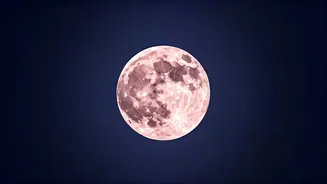
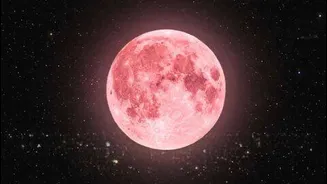
Prepare for an extraordinary celestial event as the first full moon of spring, traditionally known as the 'Pink Moon,' is set to reach its peak illumination.
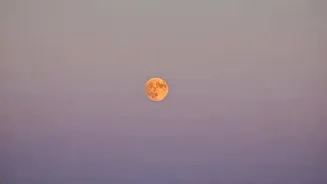
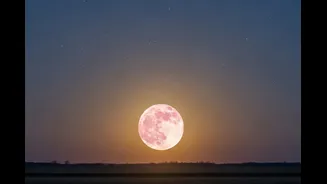
While the official peak occurs at 3:12 am on Thursday, April 2nd, skywatchers are advised that the evening of Wednesday, April 1st, presents the prime opportunity for viewing, especially as the moon ascends the horizon. Contrary to what its name might suggest, this moon is not expected to display a pink hue. The moniker 'Pink Moon' originates from ancient Native American traditions, where lunar cycles were used to track the changing seasons. This particular full moon was named in honor of the vibrant pink wildflowers, such as the wild ground phlox, that typically bloom in abundance at the onset of spring, blanketing the landscape with color. Instead of pink, observers can anticipate the moon exhibiting a warm palette of orange, copper, or a rich golden yellow as it rises.
The Science of Color
The striking orange or golden appearance of the rising 'Pink Moon' is a fascinating result of atmospheric optics. When the moon is low in the sky, the light reflecting from its surface must traverse a significantly longer path through Earth's atmosphere before reaching our eyes. Our atmosphere is populated with countless particles that interact with sunlight. As the moon's light passes through this dense medium, shorter wavelengths of light, such as blue and violet, are scattered away in various directions. The longer wavelengths, including reds, oranges, and yellows, are more resilient and manage to penetrate the atmospheric interference. This phenomenon is precisely what causes the breathtaking, fiery hues we often see during sunsets, and it's the same scientific principle that lends the rising 'Pink Moon' its warm, coppery glow.
Celestial Companion: Spica
Adding an extra layer of wonder to this month's lunar display, the 'Pink Moon' will be accompanied by a brilliant celestial neighbor. Astronomy enthusiasts should direct their gaze towards an exceptionally bright point of light situated very close to the full moon. This prominent beacon is not just an ordinary star; it is Spica, a magnificent binary star system located within the constellation Virgo. The close proximity of Spica to the luminous full moon creates a visually dynamic and captivating scene in the night sky, offering a double treat for those observing the heavens.
Holiday Calendar Influence
Beyond its visual appeal, the 'Pink Moon' holds profound cultural and religious significance, directly influencing the timing of major global celebrations. It serves as a crucial marker for determining the dates of both Easter and Passover. The ancient tradition dictates that Easter is observed on the first Sunday that immediately follows the first full moon occurring after the spring equinox. Given that this year's astronomical spring equinox fell on March 20th, the April full moon acts as the definitive trigger for this year's Easter celebration. Consequently, this lunar event precisely locks in the dates for the upcoming holiday weekend, connecting celestial cycles to important human observances.
Weather Watch
As with any astronomical event, optimal viewing conditions are contingent upon favorable weather patterns. For observers in the UK, the forecast presents a mixed outlook. Current meteorological predictions indicate that skywatchers in England and Wales may encounter difficulties, with expectations of heavy cloud cover and intermittent rain on Wednesday night potentially obscuring the lunar spectacle. However, the northern regions are anticipated to fare better. Scotland and Northern Ireland are currently under the influence of colder air masses, which generally results in clearer skies, thus offering a higher probability of uninterrupted viewing opportunities for the 'Pink Moon.'