




MAVEN's Role Explored
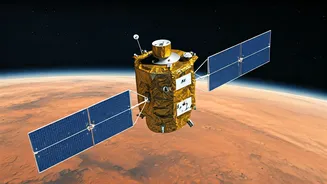
The Mars Atmosphere and Volatile EvolutioN (MAVEN) mission, launched by NASA in November 2013, has been a key instrument in understanding the Martian atmosphere.
Its primary mission is to explore how the Red Planet's atmosphere and climate have changed over time. The spacecraft is equipped with a suite of scientific instruments to analyze the composition and structure of the Martian upper atmosphere, the effects of the solar wind on the atmosphere, and how atmospheric gases escape into space. MAVEN has been instrumental in providing essential data on the interaction between the sun's energy and Mars' atmosphere. The data collected helps scientists understand the planet's past climate and why it transformed from a potentially habitable world to its present state. MAVEN's observations, combined with data from other missions, offer invaluable insight into the environmental conditions that may have once supported life on Mars and the factors contributing to the planet's present inhospitable environment.
The Communication Failure
The recent disruption in communication with the MAVEN orbiter is a significant setback for the mission and the broader scientific community. Contact was lost while MAVEN was positioned on the far side of Mars, a location that temporarily blocks direct communication with Earth due to the obstruction by the planet itself. The orbiter was designed to communicate with Earth through NASA's Deep Space Network (DSN), but the specifics of the current failure are yet to be disclosed in detail. Engineers are working to understand the cause of the communication breakdown. They are trying to find the source of the problem, whether it's related to the spacecraft's hardware, software glitches, or external factors. Restoring communication is a high priority, and NASA's team is dedicated to diagnosing the issue and working on recovery strategies. The loss of contact hinders the collection of crucial data and disrupts the ongoing scientific investigations related to the Martian environment.
Impacts on Mission Data
The inability to communicate with MAVEN directly affects the ongoing collection of data essential for understanding Mars. The mission gathers vital data on the Martian atmosphere, its interaction with solar radiation, and the planet's climate. The information is instrumental in deciphering the processes that have transformed the planet's environment. Without this data, scientists are unable to monitor the current state of Mars' upper atmosphere, including its temperature, density, and composition. Moreover, the loss of contact halts the ability to observe the escape of atmospheric gases into space, a critical aspect in explaining the evolution of Mars' climate. Scientists rely on the continuous flow of data to monitor and analyze the planet's atmospheric changes. The suspension of data flow will lead to gaps in understanding, as the information is essential for validating theories and updating climate models, which will delay the pace of scientific exploration.
Recovery Efforts Underway
NASA's engineers are currently engaged in a dedicated effort to re-establish communication with the MAVEN orbiter. The priority is to understand the root cause of the communication failure. The teams are meticulously analyzing the data from the spacecraft's last transmissions. They are looking into the health of its onboard systems. They are also assessing potential external factors that might have caused the issue. Multiple strategies are being employed to try and regain contact, including sending commands and waiting for the spacecraft to respond. The ground teams will also monitor signals that might indicate the spacecraft is still functioning. This could involve using the Deep Space Network to listen for any possible beacon signals. The task requires patience and precision, as the process of restoring contact with a spacecraft millions of miles away is a complex one. The potential solutions could vary depending on the identified cause of the communication failure, and the recovery timeline remains uncertain.
Future Mission Implications
The communication failure with MAVEN holds significant implications for future Mars missions. The incident emphasizes the need for robust communication systems and contingency planning in spacecraft design. Lessons from the MAVEN situation will aid engineers in improving future missions. They will refine communication protocols and develop more reliable hardware. Further missions to Mars, whether they involve rovers, orbiters, or potential human missions, rely on the successful exchange of data and commands with Earth. Therefore, improving the robustness of these communication systems is critical for ensuring the safety and efficiency of future explorations. These experiences serve as a reminder of the challenges of deep space exploration and the importance of resilience in the face of unforeseen circumstances. The incident with MAVEN will undoubtedly inform the design and operation of upcoming interplanetary missions and encourage innovations in communication technology.