



Tracking the Comet
The Transiting Exoplanet Survey Satellite (TESS) played a crucial role in observing interstellar comet 3I/ATLAS during its passage. TESS, with its broad
field of view, was able to record the comet as a bright, fast-moving point against a crowded starfield. Data gathered in earlier January observations was used by Daniel Muthukrishna of the Massachusetts Institute of Technology (MIT) to create a 28-hour video of the comet’s journey. Unfortunately, the observation was paused when the spacecraft faced a problem with its solar panels, which resulted in a time jump within the video from January 15 to January 18. This endeavor demonstrated TESS's ability to monitor these objects, offering a valuable perspective on their movements and characteristics.
What Is 3I/ATLAS?
Interstellar comet 3I/ATLAS is not of local origin; it originated from outside our solar system, making it an extraordinary subject of study. Its behavior and appearance are consistent with that of a typical comet, according to NASA. Comet 3I/ATLAS provided a rare opportunity for scientists to study an object from outside our solar system, observing its composition and trajectory. Investigations using probes and telescopes helped scientists better understand the structure and makeup of such objects, offering a unique perspective on celestial bodies beyond our own planetary boundaries. The study of this comet offers insights into the wider universe and the elements present beyond our solar neighborhood.
Observing the Comet
Multiple instruments were deployed to examine comet 3I/ATLAS, enhancing our understanding of its behavior. Among these, the Hubble Space Telescope and the JUICE Jupiter probe captured new images, adding to the data set. Additionally, the China’s Tianwen 1 Mars probe also took images of the comet. These observations enabled scientists to study the comet's structure and the way it interacted with its environment, especially as it moved through space. Observing 3I/ATLAS not only provided details about the comet itself but also helped develop and enhance observational techniques and strategies for studying other interstellar objects.
Comet Composition
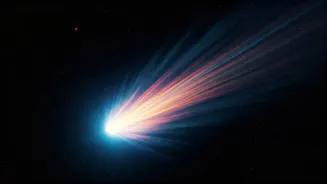
Comets are primarily composed of ice, dust, and rocky materials. As they approach the sun, the heat causes the ice to vaporize, creating a glowing head and tail. The head of a comet, also known as the coma, is the bright, fuzzy cloud that surrounds the nucleus. The tail is formed due to solar wind pushing away the vaporized material, and it always points away from the sun. The composition provides clues about the conditions and materials present during the formation of the solar system, making them valuable tools for understanding the early universe. Studying the tails of comets, as they pass through the solar system, provides information about the comet's internal structure and material.
Comets and the Sun
The material from a comet experiences significant changes as it gets closer to the sun. The heat causes the ice to vaporize, creating a glowing head, also known as the coma, and forming a tail that always points away from the sun. This process is called outgassing, and it results in the release of dust and gases. As comets travel around the sun, they lose material with each pass, and their structure can be altered. Some comets can break apart or disintegrate over time. This interaction reveals the comet's composition and provides information about the solar environment. The behavior of comets provides insight into the effects of the sun on these icy bodies.
Future Observations
Scientists continue to track and study interstellar comet 3I/ATLAS, anticipating further insights from these observations. Additional data is expected to clarify details regarding its composition, movement, and potential interactions within our solar system. The data gathered helps refine current models and contribute to the understanding of interstellar objects. Scientists are actively seeking more ways to observe such celestial bodies. The ongoing research builds upon the foundation of initial observations, constantly refining our understanding of the universe and its phenomena.