






Lion-Tailed Macaque
The lion-tailed macaque, an endangered primate, is an iconic resident of the Western Ghats, instantly recognizable by its distinctive silver mane and tufted
tail. These primates predominantly inhabit the dense forest canopies, spending the majority of their lives aloft and rarely descending to the ground. They typically live in small, scattered family groups. Their arboreal lifestyle means they are deeply connected to the health of the forest ecosystem, relying on its fruits and insects for sustenance. Conservation efforts are crucial for the survival of this charismatic species, which serves as a living emblem of the Ghats' unique natural heritage and the ongoing need to protect its fragile environment.
Nilgiri Tahr Majesty
Residing in the higher altitudes of the Western Ghats, the Nilgiri tahr is a species of mountain ungulate renowned for its exceptional agility on rocky terrain. These animals are often observed navigating steep cliffs and grassy meadows with remarkable sure-footedness. While their populations once faced severe decline, dedicated conservation initiatives have played a significant role in stabilising their numbers and ensuring their continued presence in their native habitat. The tahr's adaptation to these challenging mountainous environments is a testament to nature's resilience. Protecting these high-altitude grasslands is paramount for the long-term survival of this magnificent creature.
Malabar Giant Squirrel
The Malabar giant squirrel, also known as the Indian giant squirrel, is a strikingly colourful mammal that enlivens the forest canopy with its presence. This arboreal rodent is known for its impressive leaping ability, effortlessly gliding between trees in pursuit of food and shelter. Its multi-hued fur, often a vibrant mix of browns, reds, and yellows, makes it one of the most visually captivating creatures in India's diverse wildlife. These squirrels are primarily herbivorous, feeding on fruits, nuts, and seeds, thereby playing an indirect role in forest regeneration through seed dispersal. Their vibrant appearance and dynamic movements add a splash of colour to the dense green landscape.
Purple Frog's Secret
The purple frog is one of Earth's most unusual amphibians, spending almost its entire existence burrowed deep underground. This peculiar habit means it remains largely unseen by humans, surfacing only for a brief period during the monsoon season specifically for the purpose of breeding. Its ancient lineage and unique lifestyle have led it to be classified as a 'living fossil,' offering a direct link to prehistoric amphibian forms. The emergence of these frogs during the heavy rains is a fascinating natural event, showcasing a life cycle adapted to extreme subterranean conditions. Understanding and protecting their underground habitats is key to their survival.
Nilgiri Langur Grace
The Nilgiri langur is a shy and beautiful primate inhabiting the dense forests of the Western Ghats. It is easily distinguished by its glossy black fur, which contrasts sharply with a distinctive golden-brown head. These langurs are primarily folivorous, subsisting on a diet rich in leaves, supplemented by fruits and flowers found within their forested environment. Their elusive nature makes them challenging to observe, but their presence signifies a healthy, undisturbed forest ecosystem. They typically live in small social groups, moving through the trees with a deliberate grace. Conservation efforts focus on preserving their forest homes and ensuring their continued peace.
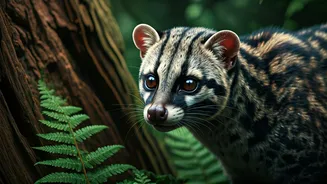
Malabar Civet Rarity
Considered one of the rarest mammals globally, the Malabar civet is a nocturnal creature whose sightings are exceptionally infrequent. This elusive animal has been pushed to the very brink of extinction, primarily due to extensive habitat loss and fragmentation across its natural range. Its nocturnal habits further contribute to its mysterious and seldom-seen nature. The severe reduction in its preferred forest habitats means that surviving populations are often isolated, making them extremely vulnerable. Conservationists are working diligently to protect the remaining pockets of habitat and understand the ecological needs of this critically endangered species.
Indian Flying Lizard
The Indian flying lizard is a fascinating reptile that exhibits a remarkable adaptation for arboreal life: the ability to glide between trees. While it doesn't possess true flight, it utilizes specialized membranes along its body to expertly navigate the forest canopy, much like a living kite. This gliding allows it to escape predators, move efficiently between feeding sites, and traverse its forested environment. Furthermore, this lizard is a master of camouflage, its skin pattern and texture allowing it to blend seamlessly with tree bark, making it incredibly difficult to spot. Its presence is a subtle indicator of a healthy, mature forest ecosystem.
Malabar Grey Hornbill
Endemic to the Western Ghats, the Malabar grey hornbill is a striking fruit-eating bird characterized by its prominent, large, curved beak. These birds play a vital ecological role within their habitat as primary seed dispersers, contributing significantly to the regeneration and maintenance of forest vegetation. Their loud, distinctive calls echo through the forest, often serving as an auditory clue to their presence long before they are seen. The hornbill's diet consists mainly of various fruits, making them integral to the plant life cycles in the region. Their unique appearance and ecological function underscore their importance to the Western Ghats' biodiversity.
Travancore Tortoise
The Travancore tortoise is a rare species of tortoise that thrives in the dense, humid environment of the Western Ghats' forests. This species prefers to inhabit areas with thick leaf litter and dense undergrowth, conditions that provide excellent camouflage and suitable living conditions. Despite its relatively large size, its reclusive nature and the nature of its habitat make it exceptionally difficult to spot. They are typically slow-moving, spending their time foraging for vegetation and remaining hidden within the forest floor. Protecting the integrity of these forest floor environments is essential for the survival of this elusive chelonian.
Nilgiri Marten Elusiveness
Representing India's sole marten species, the Nilgiri marten is an exceptionally elusive carnivore, rarely encountered by researchers or the public. This mammal is considered one of the least-studied species within the country, largely due to its shy behaviour and preference for dense, undisturbed forest habitats. Its diet consists of small animals, fruits, and insects, showcasing its opportunistic foraging habits within the ecosystem. The scarcity of sightings makes understanding its ecological role and population dynamics a significant challenge. Conservation efforts are focused on preserving its natural habitat, hoping to provide a sanctuary for this mysterious predator.