



Electric Propulsion Powerhouse
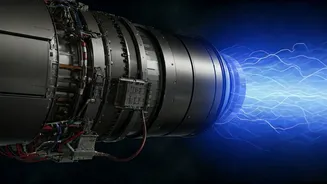
Traditional rockets rely on burning fuel, but ion engines work on a different principle. They employ electromagnetic fields to accelerate charged particles,
or ions, out of a nozzle, creating thrust. While their initial push might be gentle, this thrust builds up over time to achieve remarkable speeds. A key advantage is their incredible fuel efficiency, using up to 90% less propellant than chemical rockets. This dramatically reduces the overall mass of a spacecraft, making launches more affordable and enabling longer missions. NASA's current most advanced ion engine, found on the Psyche spacecraft, can accelerate to an astonishing 124,000 miles (200,000 kilometers) per hour. This new prototype, however, represents a monumental leap in power, marking a significant advancement in electric propulsion technology.
Lithium-Fed Innovation
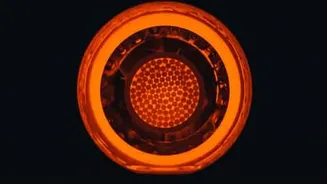
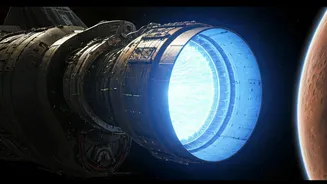
The recent breakthrough involves a novel prototype ion engine, a lithium-fed magnetoplasmadynamic (MPD) thruster. Unlike engines that typically use xenon gas, this innovative design utilizes metallic plasmas. During its initial tests within a specialized 26-foot (8-meter) vacuum chamber at NASA's Jet Propulsion Laboratory, known as the Comet facility, the engine achieved impressive results. It underwent five test firings, successfully reaching a power level of 120 kilowatts. This output is a staggering 25 times greater than that of the Psyche spacecraft's ion engine, demonstrating its immense potential for future space endeavors.
Scaling Up for the Stars
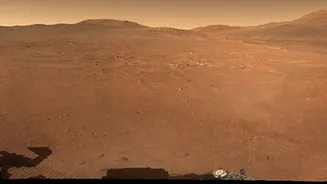
The successful testing of the lithium-fed MPD thruster is a culmination of years of dedicated design and development. Scientists are thrilled not only that the engine functions as intended but also that it met its ambitious power targets. The next phase involves significant scaling. The immediate goal is to reach power outputs between 500 kilowatts and one megawatt within the next few years. Looking further ahead, the vision is to create ion engines capable of accelerating ions with up to four megawatts of electrical power. Such advanced engines, potentially employed in multiple units on a single spacecraft, could drastically reduce travel times to destinations like Mars, making human expeditions more feasible.
Overcoming Power Limitations
A significant challenge for current ion engine missions is their reliance on solar power, typically gathered through large solar arrays. This method has two primary drawbacks: its effectiveness diminishes significantly in the outer solar system, far from the sun's rays, and the amount of power generated is inherently limited. To overcome these constraints, NASA is concurrently pursuing a space nuclear propulsion project. This initiative aims to equip missions with small nuclear reactors to generate abundant energy for ion engines, particularly crucial for deep space exploration where solar power is insufficient. The convergence of enhanced ion engine technology and nuclear power sources is seen as the key to enabling the first crewed missions to Mars.