






A Busy Weekend
Recent events in Red Rock Canyon, Nevada, highlighted the inherent risks of this popular desert destination, even for those seeking a short outing from
Las Vegas. Over a single three-day period in mid-March, search-and-rescue teams were deployed for six distinct operations. These involved rescuing five hikers and one climber, none of whom sustained life-threatening injuries. However, as Las Vegas SAR Officer TJ Keller emphasized, this busy spell served as a stark reminder that even seemingly tame wilderness requires thorough preparation. One instance involved hikers losing their way on a trail that narrowed into a less-defined path, leading one individual to become separated and subsequently found dehydrated and suffering mild hypothermia. Other incidents included a rock climber's leg injury from a fall, a hiker breaking an arm after slipping, and another individual becoming too dehydrated to continue. These occurrences, while not entirely unprecedented for the area, pointed to a combination of factors, including the arrival of warmer spring weather drawing more visitors, and the canyon's proximity to a large urban center which attracts unprepared individuals.
Wilderness Near Vegas
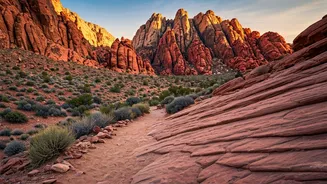
The striking sandstone formations of Red Rock Canyon present a deceptive dichotomy: it's a rugged wilderness yet remarkably close to the vibrant lights of Las Vegas, situated approximately 20 miles to its west. This accessibility often leads hikers to underestimate the environment, assuming that a short distance from the road means a simple, safe excursion. However, experts like Officer Keller stress that despite its ease of access, Red Rock remains a wild expanse characterized by challenging terrain and significant variations in elevation. The park's landscape spans from around 3,600 feet on the desert floor to over 8,000 feet in its higher reaches, with neighboring Mount Charleston extending even further. This dramatic topography, combined with extreme temperature fluctuations—summer highs exceeding 100°F and winter nights dropping below freezing—creates a volatile environment. Even during shoulder seasons like March, daytime temperatures can reach the 70s, only to plummet into the 40s after sunset, necessitating careful consideration of both attire and timing.
Preparation is Key
The common thread linking the various rescue incidents at Red Rock Canyon is a deficiency in preparation. Whether it's an inadequate fitness level for the chosen trail, insufficient or inappropriate gear, or a lack of thorough route research, visitors frequently arrive ill-equipped for the desert's demands. Officer Keller highlighted that for excursions in March, essential items include ample water, suitable clothing layers, and offline navigation tools like downloaded GPS maps, especially since cellular service can be unreliable. The park's trails are notorious for their unpredictable nature; a path that begins as a gentle stroll can quickly transform into a strenuous climb requiring scrambling over boulders or navigating narrow passages, testing a hiker's agility and resolve. Therefore, diligent planning—including researching trail specifics, anticipating weather patterns, and ensuring one possesses the correct hiking equipment—is paramount for anyone intending to explore the Red Rock area.
Night Rescue Tip
A simple yet often overlooked strategy for individuals lost or stranded overnight in Red Rock Canyon involves utilizing a mobile phone's flashlight. In the case of an 80-year-old hiker who became disoriented and spent the night lost, Officer Keller noted that the individual possessed a fully charged phone but failed to employ its light as a signaling device. Although cellular service was unavailable, the phone's illumination would have been visible to the search-and-rescue team's thermal imaging equipment, potentially expediting his discovery. This incident underscores a crucial survival tip: even without service, a phone's light can serve as a vital beacon. It also serves as a poignant reminder of Red Rock's deceptive character; while the distant glow of Las Vegas may be visible, unprepared visitors can still find themselves plunged into complete darkness and isolation.