





The Cold Moon Arrives
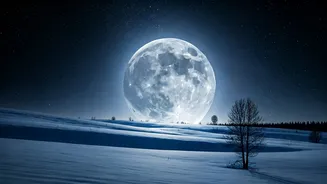
The highlight of December's celestial calendar in 2025 is the appearance of the 'Cold Moon', also recognized as the 'Moon Before Yule'. This full moon
occurs in the closing phase of a 'Major Lunar Standstill,' an event that recurs every 18.6 years. This phenomenon means the moon's orbit is at its most tilted angle relative to Earth's orbit. Consequently, the lunar disk will rise from a more northerly point on the horizon, soaring higher than usual in the autumn sky. The 'Cold Moon' isn't just a visual treat; it also presents itself as a 'supermoon', appearing up to 30% brighter and potentially 14% larger than the smallest moon of 2025. This makes it an especially captivating sight for stargazers, coinciding with the typical cold weather conditions in the Northern Hemisphere during this time of the year. The last full moon of 2025 will be visible on December 4th at sunset, making it a perfect time to witness this event.
Supermoon Spectacle
The 'Cold Moon' is also a supermoon, occurring as the moon reaches perigee, its closest point to Earth in its monthly orbit. This proximity gives rise to a supermoon, making it appear brighter and larger. Specifically, the 'Cold Moon' could appear up to 30% brighter and 14% larger than the smallest moon of the year. This supermoon phenomenon enhances the visual appeal of the last full moon of the year, making it a spectacular sight for observers. This supermoon’s visibility offers a prime opportunity for amateur astronomers and casual skywatchers to witness the beauty of a larger-than-usual moon, providing a memorable experience as the year closes. This event underscores how the varying distances of the moon from Earth can significantly alter its appearance in the night sky.
Viewing Opportunities
For those eager to observe the December 2025 celestial events, particularly the 'Cold Moon,' there are several avenues to consider. The article suggests that watching the lunar spectacle can be done from the comfort of one's home through free livestreams. Such livestreams, as provided by sources like the Griffith Observatory and the Virtual Telescope Project, offer an accessible way to witness astronomical events without the need for specialized equipment or travel. These livestreams typically provide high-quality views of the moon and other celestial objects, enhancing the viewing experience. These online resources are also ideal for individuals in areas with unfavorable weather conditions or light pollution, ensuring they don't miss out on the beauty of the night sky.
Geminid Meteor Shower
December 2025 also offers the exciting Geminid meteor shower, which is anticipated to be one of the year’s best. This meteor shower is known for its high rates of meteors, making it a must-see event for meteor enthusiasts. The Geminids are active throughout December, with the peak occurring around mid-month. Those looking to observe the Geminids should know that these meteors are often bright and colorful, originating from the constellation Gemini. Viewing the Geminids is best in a dark location away from city lights, with the possibility of seeing numerous meteors per hour. Timing and location are important to maximize viewing potential. The absence of a bright moon during the peak can enhance the visibility of the shower, making the Geminids a particularly worthwhile celestial event to watch.
Planetary Alignments
Besides the 'Cold Moon' and the Geminid meteor shower, December 2025 offers other celestial events, including planetary alignments. Observers can look forward to seeing the bright planets, such as Jupiter and Saturn. In late November 2025, Saturn will shine with the waxing moon, creating a picturesque scene at sunset. Furthermore, on December 7th, Jupiter will be close to the waning gibbous moon, offering another beautiful conjunction to observe. These planetary events, viewed alongside the moon, will provide captivating displays in the night sky. The article emphasizes how these planetary arrangements add to the month's celestial offerings, presenting ample opportunities for sky watchers to witness the beauty of the solar system.