




Artemis Mission Complexity
The Artemis 3 astronaut test flight is poised to be one of NASA's most intricate endeavors to date. This mission is designed to push the boundaries of human
space exploration, building upon the foundational success of Artemis 2. The complexity arises from the ambitious objectives, including landing astronauts on the lunar surface and establishing a sustainable presence. This involves the development and integration of advanced technologies, such as new lunar landers and life support systems, all of which require rigorous testing and validation. The planning and execution of such a mission demand meticulous attention to detail, extensive astronaut training, and seamless coordination among numerous engineering and scientific teams. The mission's success hinges on overcoming numerous technical hurdles and ensuring the safety of the crew throughout their extended stay on the lunar surface. The preparatory missions, like Artemis 2, are crucial for testing systems and procedures that will be vital for the more demanding Artemis 3.
Lunar Photography Goals
The Artemis 2 astronauts are tasked with capturing extraordinary images of the Moon during their historic flyby. This scientific objective extends beyond mere documentation; it aims to gather crucial data and provide new perspectives on our celestial neighbor. The astronauts will be trained by lunar scientists to observe and photograph the Moon with a deeper understanding, potentially identifying geological features and understanding the lunar environment in unprecedented detail. Their photographic efforts will focus on aspects rarely seen up close, offering insights into the Moon's surface composition, topography, and evolution. These images will contribute significantly to our ongoing scientific study of the Moon and inform future exploration missions. The training emphasizes how to 'see the moon with different eyes,' suggesting a focus on scientific interpretation and data acquisition rather than just aesthetic appeal, promising a rich harvest of scientific discovery.
Tracking Artemis 2
For enthusiasts eager to follow the Artemis 2 mission, tracking the spacecraft's journey around the Moon is made accessible. Methods exist to monitor the astronauts' progress, allowing the public to feel more connected to this monumental endeavor. Beyond visual tracking, amateur astronomers with specialized equipment, such as Unistellar smart telescopes, can participate in citizen science initiatives. These telescopes are capable of tracking the light curve of celestial objects, and can even be used to observe the faint signature of the Artemis 2 rocket as it travels. This capability allows for scientific data collection, contributing to the broader understanding of the mission's trajectory and performance. Observing the rocket's light curve in the name of science offers a unique way for individuals to engage directly with space exploration.
Mission Milestones and Views
The Artemis 2 mission is marked by several significant achievements, including a record-breaking lunar loop. The astronauts aboard the Orion spacecraft have captured stunning views of Earth, showcasing its beauty from the vastness of space. These images, often compiled into timelapse videos, offer a profound perspective on our home planet. Furthermore, the mission has yielded breathtaking celestial photography, such as a remarkable shot of swirling stars, highlighting the clarity and darkness of space far from Earth's light pollution. The astronauts' experiences, like observing Earth from their spacecraft, provide unique insights into the human aspect of space travel. The mission's success in navigating and observing the lunar environment is a testament to the advancements in space technology and human ingenuity.
Related Space Ventures
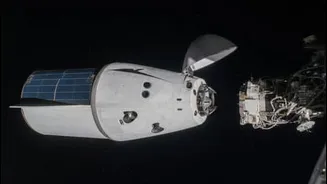
The Artemis program is not the sole frontier of current space exploration. Other significant missions are underway, expanding our knowledge of the solar system. For instance, NASA's Psyche spacecraft is en route to a metal-rich asteroid, a mission that surprisingly included a flyby of Mars to gain momentum. This illustrates the interconnectedness of various space exploration objectives, where even seemingly distant targets are part of a larger strategic approach. Concurrently, the International Space Station continues its vital work, receiving supplies and scientific equipment via SpaceX Dragon capsules, underscoring the ongoing international collaboration in space. These diverse missions, from lunar exploration to asteroid belt studies, collectively paint a picture of a vibrant and expanding era of space science and discovery.