



Gravity in Space
The Energia rocket company, a Russian state-owned enterprise, has secured a patent for a novel spacecraft architecture designed to produce artificial gravity,
a feature that could drastically improve long-duration crewed missions. The implications of this are quite extensive. Exposure to the unique environment of microgravity in space presents a series of challenges for astronauts. Extended periods in this weightless environment can lead to muscle atrophy and a decline in bone density. This new design seeks to counteract these negative health consequences, potentially making longer space journeys safer and more viable. The potential benefits extend beyond health; the ability to simulate Earth's gravity could also improve the overall comfort and performance of astronauts during extended missions, impacting the future of space exploration and encouraging further research in this field.
Design Elements
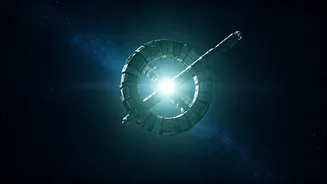
The patented design features a central axial module with both stationary and rotating elements, interconnected by a sealed, flexible junction. This configuration is key to the system's function. Attached radially to the central axis are the habitable modules. These modules would be rotated around the central axis to create artificial gravity. The process involves creating an outward-pushing centrifugal force, which simulates gravity for the crew inside. To achieve a gravitational force equivalent to 0.5g (half of Earth's gravity), the modules would need to rotate at approximately five revolutions per minute. The radius of these modules would need to be 131 feet (40 meters) to achieve this level of gravity simulation. Constructing such a space station would require multiple launches to transport the various modules to orbit, followed by on-orbit assembly to complete the structure. This suggests a complex engineering endeavor.
Addressing Challenges
The design does acknowledge certain challenges inherent in the rotating system. The need to spin and coordinate the rotation of transport ships to dock with the station is mentioned in the patent documentation. This aspect, specifically, is noted to potentially reduce the safety of docking procedures. The patent provides some important observations about the challenges. Russia has not made any announcements detailing project timelines or committed resources for the development of this project. Despite these uncertainties, the patent reflects Russia's interest in advancing space technology, especially given the impending decommissioning of the International Space Station (ISS). NASA and Roscosmos have a plan to deorbit the ISS in 2030, a move that will see the station enter Earth's atmosphere and be destroyed over the Pacific Ocean. Russia has committed to remaining on board the ISS until 2028.