





AI's New Frontier
In a groundbreaking development for astronomy, artificial intelligence has been instrumental in confirming the existence of more than 100 planets located
outside our own solar system. Even more remarkably, this advanced AI system has identified over 2,000 additional signals that strongly suggest the presence of yet-undiscovered worlds. This achievement, spearheaded by researchers from the University of Warwick and detailed in the journal Monthly Notices of the Royal Astronomical Society, highlights a significant evolution in how scientific exploration is conducted. Automated systems are now capable of undertaking intricate tasks that previously demanded months of dedicated human effort from expert astronomers, marking a pivotal moment in space research.
The RAVEN System
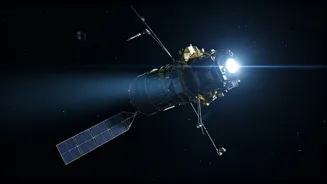
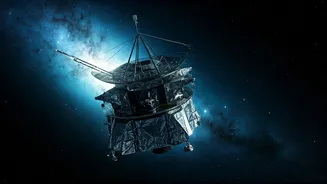
At the heart of this astronomical breakthrough lies a sophisticated AI-powered system named RAVEN. This intelligent pipeline was specifically engineered to detect celestial phenomena that might elude human observation. Rather than relying on scientists to painstakingly comb through immense volumes of telescope readings, RAVEN processes this data autonomously. It excels at recognizing subtle patterns and anomalies within the data that might be too faint or time-consuming for human eyes to identify consistently. The raw information for this research was gathered by NASA's Transiting Exoplanet Survey Satellite, or TESS, a specialized space telescope designed for continuous observation of stars and meticulous tracking of minute fluctuations in their luminosity.
Detecting Distant Worlds
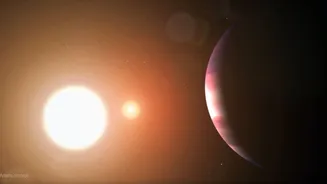
The fundamental principle behind detecting these distant planets hinges on observing slight diminutions in a star's brightness. This phenomenon occurs when a planet traverses across the face of its host star, even for a brief interval, thereby obscuring a small portion of the star's light and causing a noticeable dip in its observed brilliance. This method, widely recognized as the Transit Method, has proven to be one of the most effective and dependable techniques for identifying exoplanets. Employing this very method, the AI system, RAVEN, has successfully cataloged over 100 validated planets, including numerous newly identified ones, and has flagged more than 2,000 other potential planetary candidates deserving further investigation.
Transforming Space Research
The impact of this AI-driven approach represents a profound shift in the field of exoplanet research. Historically, the meticulous analysis of these faint signals relied almost entirely on human intervention. Astronomers would manually scrutinize light curves, verify recurring patterns, and painstakingly rule out potential false positives – a process that was both time-consuming and labor-intensive. However, the sheer volume of data collected by modern telescopes has escalated dramatically. Tools like RAVEN are now indispensable for scientists, enabling them to efficiently sift through this colossal dataset and pinpoint the most promising celestial candidates in a fraction of the time. This technology is not replacing astronomers but rather redefining their roles, freeing them to concentrate their expertise on the crucial tasks of confirmation and in-depth scientific analysis of these newfound worlds.